T.O AN 16-40BC348-3

HANDBOOK

MAINTENANCE INSTRUCTIONS

RADIO RECEIVERS

BC-348-J BC-348-N BC-348-Q

THIS PUBLICATION REPLACES T.O. AN-08-10-112 DATED 18 DECEMBER 1943

PUBLISHED UNDER AUTHORITY OF THE SECRETARY OF THE AIR FORCE

REVISED 21 JUNE1948

OCR by Bill, NJ7P

From a partial Manual from

Fair Radio Sales

This manual is missing the comprehensive parts lists and some of the pictures from the original manual. The full text and key data is present.

TABLE OF CONTENTS

I. GENERAL DESCRIPTION
  1. GENERAL.
  2. COMPONENT UNITS.
  3. CABINET.
  4. CHASSIS.
  5. DIAL AND MASK ASSEMBLY.
  6. DYNAMOTOR.
  7. I-F TRANSFORMERS, CRYSTAL FILTER, C-W OSCILLATOR.
  8. MOUNTING.
  9. PANEL.
  10. PLUG.
  11. R-F AND OSCILLATOR UNITS.
II. INSTALLATION AND ADJUSTMENT
  12. INITIAL PROCEDURE.
  13. INSTALLATION.
  14. PREPARATION FOR USE.
III. OPERATION
  15. PROCEDURE.
IV. MECHANICAL AND ELECTRICAL CHARACTERISTICS
  16. CIRCUITS.
  17. FREQUENCY RANGE AND BANDS.
  18. INPUT COUPLING.
  19. RADIO FREQUENCY AMPLIFIER.
  20. FIRST DETECTOR.
  21. HETERODYNE OSCILLATOR.
  22. INTERMEDIATE FREQUENCY AMPLIFIER.
  23. C-W OSCILLATOR.
  24. CRYSTAL BAND-PASS FILTER.
  25. SECOND DETECTOR.
  26. OUTPUT.
  27. DYNAMOTOR DM-28-(*).
V. MAINTENANCE
  28. INSPECTION.
  29. DYNAMOTOR SERVICE ANDMAINTENANCE.
  30. REMOVAL OF FRONT PANEL.
  31. DIAL AND MASK ASSEMBLY.
  32. SERVICING THE DIAL AND MASK ASSEMBLY.
  33. REMOVAL OF ANTENNA, R-F, DETECTOR AND OSCILLATOR UNITS
  34. TROUBLE LOCATION AND REMEDY.
VI. SUPPLEMENTARY DATA
  35. GENERAL.
  36. CERAMIC CAPACITORS.
  37. HEATER SHUNT RESISTOR.
  38. STATIC DRAIN RESISTOR.
  39. OUTPUT CONNECTIONS.
  40. MOISTURE-FUNGUS RESISTANCE.

Handbook of

MAINTENANCE INSTRUCTIONS

For

RADIO RECEIVERS

BC-348-J, BC-348-N and BC-348-Q

SPECIAL NOTICE

Radio Receivers BC-348-J, BC-348-N and BC-348-Q are essentially alike. Therefore, reference will be made throughout the book to these receivers as follows: Radio Receiver BC-348-(*). However, all photographs and diagrams will be labeled for the "J" equipment, since it applies equally well to the other two models.
Reference to the dynamotors is mentioned in the same manner. The asterisk indicates that these units are mentioned collectively.
I. GENERAL DESCRIPTION
1. GENERAL.
Radio Receivers BC-348-J, BC-348-N and BC-348-Q are locally controlled, eight-tube, six-band superheterodyne receivers for use in U. S. Army aircraft. They cover a frequency range of from 200 to 500 kc and 1.5 to 18.0 megacycles. These receivers are designed for operation on a 28-volt power supply. Their power consumption is 60 watts with no power supplied through the output plug to external equipment. All controls are 1ocared on the front panel where they may be easily operated by aircraft personnel. Antenna, ground and headphone connections are made on the front panel. Power and interphone connections are made through a connector plug at the back of the receiver. Each receiver is capable of voice, tone and c-w reception. Either manual or automatic volume control may be selected by a switch on the front panel; likewise normal or extreme selectivity is provided by means of an i-f crystal filter that may be switched in or out of the circuit as desired. A beat frequency oscillator is employed for c-w reception. The receivers are not intended for remote control and no provision has been made for this operation.
2. COMPONENT UNITS.

Description

Size in Inches

Weight in Pounds

1 Radio Receiver BC-348-(*) Complete (Includes Dynamotor DM-28-(*) and Mounting FT-I54-J, FT-154-Q or FT-154-AA)

18 x 10 1/2 x 9 1/2 high

38.0

1 Mounting FT-I54-J, FT-I54-Q or FT-154-AA (Does not include Plug PL-P103 or PL-Q103)

18 x 8 1/2 x 1 3/8 high

3.843

1 Plug PL-P103 or Plug PL-Q103

l 5/s x 2 1/8 x 2 7/8 high

2 x 2 1/8 x 3 high

.312

.375

1 Set of 8 Vacuum Tubes, 2 Pilot Lights, 1 Fuse


.563

3. CABINET.
Radio Receiver BC-348-(*), is housed in an aluminum cabinet 18" long, 8 15/16" deep, and 8 5/8" high and is of spot-welded construction. The outside has a black wrinkle finish. An opening is provided at the rear of the cabinet for the connector plug. A plate is attached to the bottom, which reinforces the cabinet and provides a mounting for four mounting studs, A flange on the front of the plate mounts two snapslides which are used to lock the cabinet to the receiver mounting. The top and back of the cabinet are strengthened by embossed grooves that run nearly the length of the cabinet.
4. CHASSIS.
The chassis of Radio Receiver BC-348-(*) is an aluminum casting with plates mounted on both ends. These end plates have cutouts to facilitate servicing. They serve as a mounting for parts and as runners for the chassis when it is installed or removed.
5. DIAL AND MASK ASSEMBLY.
The dial and mask assembly is a casting which mounts a dial scale calibrated in six frequency ranges, a dial mask with windows, a band switch shaft, a detent wheel and mechanism, and drive gears. A stop arm provides a positive stop at each end of the frequency range. The use of split gear tuning minimizes backlash. The drive ratio is such that approximately 100 revolutions of the tuning control are required to turn the tuning capacitors through the frequency range. The assembly is mounted on the front panel, and indicates the range and frequency to which the receiver is tuned.
6. DYNAMOTOR.
Mounted at the left (from front of chassis) rear of the chassis is the dynamotor assembly. It consists of Dynamotor DM-28-(*) and an r-f filter unit that supplies all the high voltage direct current for the operation of Radio Receiver BC-348-(*). In addition to the power supplied by the dynamotor to the receiver, there is available at the connected plug 20 milliamperes at approximately 200 volts for the operation, when necessary, of accessory equipment. To remove the unit for servicing or replacement, disconnect the connections at the terminal strip and loosen the four mounting bolts at each corner of the mounting plate.
7. I-F TRANSFORMERS, CRYSTAL FILTER, C-W OSCILLATOR.
The i-f transformer assemblies are mounted on the left (from front of chassis) front section of the chassis near the i-f tubes. Fixed capacitors are used across the primaries and secondaries. They are adjusted by varying the transformer cores. On the same section of the chassis, but on the underside in front of the 2nd i-f tube socket, is the crystal filter coil. The crystal and switch may be seen from the upper side of the chassis, mounted on the front panel above the coil. With the switch in the IN position, sharp selectivity is obtained on all bands. Near the crystal filter coil, but mounted on the front panel in back of the beat frequency control knob, is the cw oscillator coil. The position in which the coil is mounted allows direct control of the variable core from the front panel for adjusting the beat frequency.
8. MOUNTING.
The mounting base is a metal plate upon which four shock absorbers are mounted. A second metal plate, with grooves and cutouts to fit the mounting studs on the bottom of the cabinet and studs to fit the snapslides, is attached to the top of the shock absorbers. A metal stiffener is attached to the bottom of this plate to strengthen the assembly, and provision is made at the rear of the plate for mounting the connector plug.
9. PANEL.
The front panel is attached to the chassis. The controls, the input and output connections, and the handles are located on it. Through the lower part of these handles pass thumbscrew rods that fasten the chassis to the cabinet. On the right side of the panel is a small metal plate held in place by six screws and covering an opening that gives access for servicing to the underside of the r-f tube shelf. Both the front panel and the r-f tube shelf plate have a black wrinkle finish. White lettering identifies each control and indicates the switch positions.
10. PLUG.
The eight-contact connector plug which provides power connections at the rear of the receiver is mounted by screws on the receiver mounting. The wiring terminals are accessible by removing the rear cover on the plug housing. The connector, when provided with a straight fitting, is identified as Plug PL-P103. When it is provided with a right angle fitting, it becomes PL-QI03, regardless of whether the fitting is mounted toward the right, left or back of the receiver.
11. R-F AND OSCILLATOR UNITS.
The antenna, r-f, 1st detector and oscillator units are sub-assemblies consisting of a shield can, coils, trimmer condensers, band switch section, resistors, fixed capacitors and in the oscillator unit, the 1st detector and oscillator tube, Tube VT-150. The four units are mounted at the right (from front of chassis) rear of the chassis and bonded together by common ground straps. The band switch sections are ganged by connecting the arms on the switch shafts together with slotted bars and tension springs, and are controlled as a unit from the front panel.
II. INSTALLATION AND ADJUSTMENT
12. INITIAL PROCEDURE.
a. UNPACKING.
Radio Receiver BC-348-(*) is packed in a wooden box with Mounting FT-154-J, FT-154-Q or FT-154-AA. To unpack the receiver preparatory to installation, the following steps should be taken in the order given:
(1) Pull out the nails in the top of the box and remove the cover.
(2) Remove the large cardboard filler in the top of the box.
(3) Remove the cardboard carton containing Mounting FT-154-J, FT-154-Q, or FT-154-AA.
(4) With the wooden packing box placed on the floor, stand at one end, place the palms of the hands against each side of the cardboard carton containing the receiver and lift the carton from the packing box.
(5) Break the seal on the top of the cardboard carton.
(6) Remove the filler in the top of the carton.
(7) Grasp the handles on the front of the receiver and lift the receiver out of the carton.
(8) Break the seal and open both ends of the carton containing Mounting FT-154-J, FT-I54-Q, or FT-154-AA.
(9) Slide the mounting out of the carton and place with the receiver.

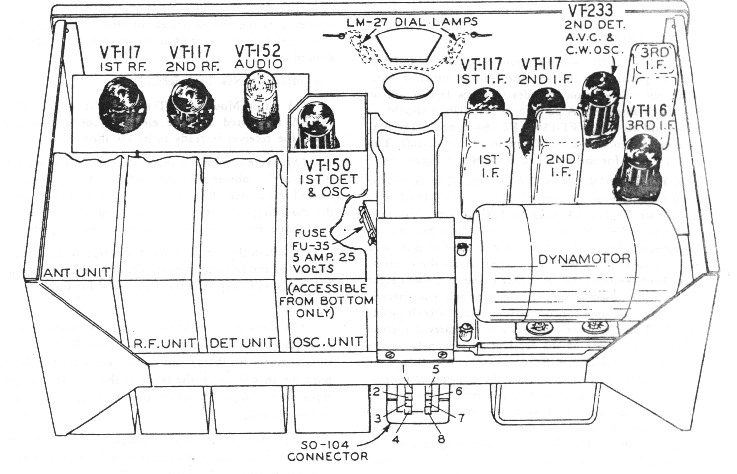
Figure 2 – Radio receiver BC-348-J, Tube Positions

(10) Loosen the thumbscrews in the lower part of the handles on the front panel and pull the chassis from the cabinet.
(11) Remove the cardboard filler over the dynamotor and replace the chassis in the cabinet.
b. INSPECTION.
(1) Figure 2 shows the position of each tube, dial lamp and fuse. Before the receiver is installed, loosen the thumbscrews in the lower part of the handles on the front panel and pull the chassis from the cabinet. Make certain the tubes are well pushed down and firmly seated, and that the fuse and dial lamps are correctly and securely inserted.
(2) The dynamotor and the electrical connections to the dynamotor must be securely fastened in position. The dynamotor is fastened by four mounting screws at the corners of the mounting plate and the electrical connections are made at a terminal strip accessible through a cutout in the left (from front of chassis) chassis end plate.
13. INSTALLATION.
a. MOUNTING.
The receiver should be mounted as near as possible to the antenna lead-in insulator with sufficient clearance on all sides to allow free action of the shock absorbers. A permanent installation should be made and Mounting FT-154-J, FT-154-Q, or FT-154-AA, securely fastened to a rigid section of the aircraft. The drilling plan for the mounting is shown in Figure 29.
b. ELECTRICAL CONNECTIONS.
The connector plug mounted on the rear of Mounting FT-154-J, FT-154-Q, or FT-154-AA ,(Figure 19), provides electrical connections between the receiver and the other aircraft equipment (Figure 32). On the rear of this plug is a cover held in place with two screws. After these screws have been removed the cover may be taken off and eight terminals exposed. Four of these terminals (numbers 3, 4, 7 and 8) are used for connections to the aircraft power supply. Two terminals, numbers 2 and 6, carry the screen voltage circuit out of the receiver to terminals on the transmitter relay so that the screen circuit may be opened and the receiver protected while the transmitter is operated. Should the transmitter be removed or the receiver be used in an installation with no transmitter, terminals 2 and 6 must be connected together in order to have the receiver operate The aircraft interphone system may be connected to terminals 1 and 5 at which the receiver output is available. These terminals may be left open if output is desired only for headphones, and the headphones plugged into jacks on the front panel. See Section II, paragraph 14b(9). Should it be necessary to supply power to additional external equipment, a maximum of 20 milliamperes at approximately 200 volts is available from terminals 2 and 5. All leads should be carefully measured and cut to the correct length, inserted through the fitting on the bottom of the connector plug and soldered to the correct terminals. After all connections have been made, check carefully to make certain that the terminals are wired correctly, and replace the cover on the rear of the connector plug. The plug may now be mounted in position. The two pair of leads carrying the power to the receiver through terminals 3, 4, 7 and 8 may be replaced with one pair of leads, each of which must have a cross sectional area equal to the two replaced leads.
c. ELIMINATION OF ELECTRICAL INTERFERENCE.
Electrical disturbances are set up by the aircraft ignition system and electrical devices. This interference must be either eliminated or lowered to a level below the strength of the signals to be received. This is accomplished by shielding the entire electrical ignition system and devices, filtering the electrical connections between the devices, and the bonding of all metal parts to a common ground.
d. MOUNTING THE RECEIVER.
(1) After Mounting FT-154-J, FT-154-Q or FT-154-AA is located and the electrical connections are made, the receiver is ready to be installed.
(2) Make certain the thumbscrew rods holding the chassis to the cabinet are tight, and push both snapslides toward the center of the cabinet. Lift the receiver onto the mounting so that the rear studs on the bottom of the cabinet are in the groove on the mounting plate.
(3) Push the cabinet towards the rear of the mounting and at the same time lower the front of the cabinet. The studs will drop into holes provided for them in the mounting.
(4) Push the receiver still farther backwards (more pressure will have to be exerted, as the studs fit into the slots provided for them), until it will go no farther. Now push the snapslides on the front of the cabinet over the studs on the mounting plate, thus locking the receiver to the mounting.
(5) Insert safety wire through the holes in the snapslides. Twist the ends together and turn the ends in so there will be no danger of scratches or minor injuries to the personnel.
e. ANTENNA AND GROUND CONNECTIONS.
The antenna and ground binding posts are on the front panel at the lower right-hand side where they may be identified by the letters "A' and "G." Connections to these binding posts should be made with short, low resistance leads having sufficient slack to prevent the transmission of vibration to the receiver. The antenna lead should connect to the antenna insulator, and the ground lead to some metal part of the aircraft where it should be soldered, if practicable. The receiver may be used with any type of antenna. However, the most efficient antenna is one which has the greatest effective length away from the grounded metal fuselage.
14. PREPARATION FOR USE.
a. INSPECTION.
After the installation has been completed, a final check on the points listed below should be made followed by an operating test:
(1) Check the connections at the aircraft power supply.
(2) Check the connections at the transmitter relay.
(3) Check the connections at the interphone system, if used.
(4) Check the power connections to auxiliary equipment, if used.
(5) Check the antenna and ground connections.
(6) Make sure the thumbscrew rods holding the chassis in the cabinet are tight.
Make sure the snapslides are locked and secured with safety wire.

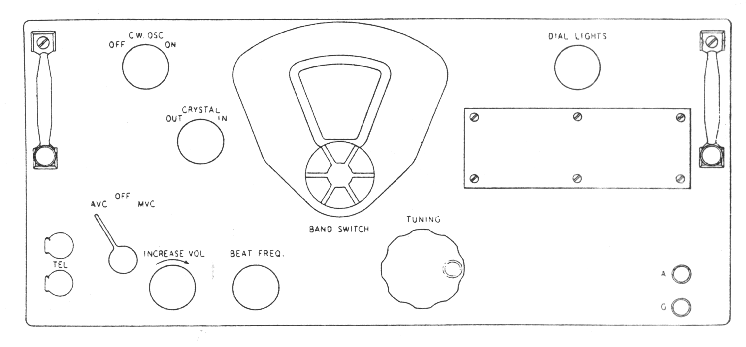
Figure 3 – Radio Receiver BC-348-J, View of front Panel

b. CONTROLS.
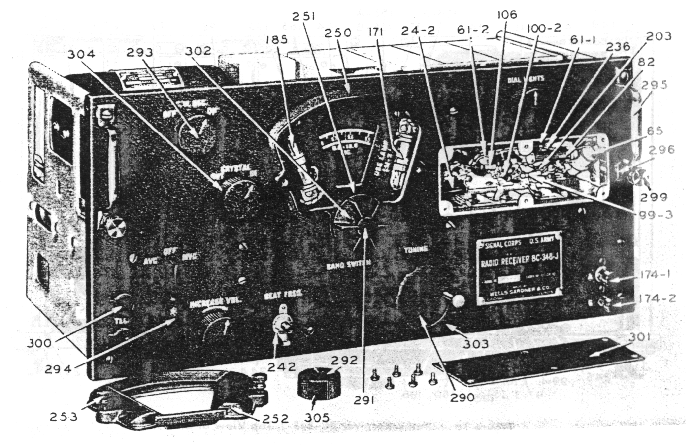
The operator should become thoroughly familiar with the controls on the front panel (see Figure 3) and their function before beginning the operating test.
(1) AVC-OFF-MVC.-- Power to the receiver is controlled by the AVC-OFF-MVC receiver switch. With this switch in the OFF position, no power is supplied to the receiver. When switched to either the MVC or AVC position, power from the primary source is supplied to the tube heaters and dynamotor, placing the equipment in operation. The screen grid voltage supply leads are carried out of the receiver through the power plug to the keying relay of the associated transmitter where the circuit is opened when actually transmitting. (See Section II, paragraph 13b).
(2) DIAL LIGHTS.--The brilliancy of the dial illumination is controlled by this knob. The dial lamps may be adjusted for any desired degree of illumination or turned off completely.
(3) BAND SWITCH. -- The frequency band in which the receiver is operating is indicated on the dial mask visible through the dial window. This band may be changed to any desired frequency band by turning the band-switch control.
(4) TUNING.--Reception is accomplished by tuning the receiver to the desired signal with this control. The frequency to which the receiver is tuned is indicated at all times on the dial scale.
(5) INCREASE VOL.--The volume level of the audio signal is controlled by this knob. When the receiver is operated with manual volume control, the sensitivity of the receiver is controlled. When automatic volume control is desired, the level of the audio signal fed into the output tube is controlled.
(6) C-W OSC.--The c-w oscillator is turned ON for c-w, or OFF for voice reception with this knob. The a-v-c time constant is also changed at the same time to conform with the type of signal to be received.
(7) BEAT FREQ.--This knob adjusts the frequency of the c-w oscillator and allows the operator to adjust the tone of the received signal to the pitch he considers the most suitable.
(8) CRYSTAL--This control inserts a crystal filter into the circuit when turned to the IN position. This filter increases the selectivity, of the receiver, enabling reception through heavy interference.
(9) TEL. JACKS.--Dual output is provided through two open circuit phone jacks. These jacks are connected to the output circuit of the receiver and permit headphone reception by the operator.
(10) ANTENNA AND GROUND BINDING POSTS.--The antenna is connected to the binding post marked "A", while the ground lead is connected to the binding post marked "G."
III. OPERATION
15. PROCEDURE.
a. OPERATING TEST.
When the receiver has been completely installed, an operating test should be made as follows:
(1) Plug a headset into one of the jacks marked "TEL." Set receiver switch to MVC. Start the dynamotor. After the tubes have warmed up (approximately 30 seconds), advance volume control knob until a slight background noise is heard. Set band switch to the frequency band in which test signals are available.
(2) Using the tuning knob with reference to the calibrated scale on the dial, tune in the desired signal.

NOTE

All tuning should be done on MVC switch with the volume control advanced only enough to give the desired signal strength. In the absence of a signal the setting of the volume control can be judged by the loudness of the background noise. On MVC with the volume control set at maximum, very strong carrier waves will block the receiver and intelligible signals cannot be received.
(3) Set the receiver switch to AVC. The desired signal should still be heard.
(4) With the beat frequency adjustment at zero beat position (arrow on knob pointing up), turn the c-w oscillator switch to the ON position. An audible beat note should be heard which should vary in pitch when the beat frequency adjustment is changed.
(5) With the c-w oscillator still on, throw the crystal filter switch to IN. Noise should be greatly reduced and the signal can be tuned out by a much smaller movement of the tuning control knob than when the crystal filter switch is in the OUT position.
(6) Turn the dial light rheostat and observe if control of illumination is secured with both dial lights functioning.
(7) A check should be made before flight with the airplane engines running. An increase of background noise when the engine starts, indicates imperfect shielding, imperfect bonding, faulty generator regulator, faulty generator, open filter capacitors, or a combination of these faults.
(8) Always turn the receiver switch to the OFF position when the receiver is not being used.
b. RECEPTION.
(1) MODULATED SIGNAL RECEPTION.-For the reception of modulated signals in the frequency bands covered by this receiver, turn the AVC-OFF-MVC switch to MVC, the C-W OSC. control to OFF and the CRYSTAL control to the OUT position.

NOTE

Tuning should be done in the MVC position with the volume control advanced only as far as required for a comfortable output level. While waiting for the tubes to warm up, adjust the dial light control for the desired dial illumination and turn the band switch to the frequency band in which the signals to be received are transmitted.
After the tubes have warmed up (approximately 50 seconds), adjust the volume control until the background noise can be heard. Turn the tuning control until the frequency of the desired signal is reached and the signal is heard in the headphones. Turn the tuning control slowly back and forth until the position at which the signal is received the strongest is found. After the signal is tuned in, if automatic volume control is desired it may be used by switching the AVC-OFF-MVC control to the AVC position and readjusting the volume control for the desired output. In the event interference is encountered, the crystal filter may be switched into the circuit, increasing selectivity and permitting reception that would be exceedingly difficult otherwise.
(2) C-W RECEPTION.--For the reception of c-w signals, turn the c-w oscillator control to ON and the beat frequency control to the zero beat position (arrow on knob pointing up). Proceed as instructed for the reception of modulated signals and when the signal is tuned in, adjust the beat frequency control to the position producing the most satisfactory tone. Automatic volume control may be used when desired by switching to the AVC position and readjusting the volume control. The crystal filter should be used to increase the selectivity of the receiver if objectionable interference is encountered. A slight readjustment of the tuning, beat frequency and volume controls may be required to secure the desired beat note frequency and volume level after the crystal filter is switched in. The sensitivity may sometimes be slightly improved by readjusting the positions of the beat frequency knob and the tuning control.

NOTE

The crystal band pass filter is intended primarily for use in c-w reception. However, the added selectivity may at times prove helpful in receiving modulated signals through heavy interference.
IV. MECHANICAL AND ELECTRICAL CHARACTERISTICS
16. CIRCUITS.
Electrically, the receiver comprises two stages of tuned radio frequency amplification preceding the first detector, a temperature-compensated heterodyne oscillator, three intermediate frequency amplifier stages, a second detector and one stage of audio-frequency amplification with a transformer output circuit. A crystal band-pass filter and beat-frequency oscillator are also included. The former is for increasing selectivity and the latter for receiving c-w signals. The schematic and wiring diagrams are shown in Section VIII.
17. FREQUENCY RANGE AND BANDS.
Six bands controlled by a band change switch are covered. The frequency range for each of the six bands is given in the following table.

Band

Frequency Range

1

200 -- 500 Kilocycles

2

1.5- 3.5 Megacycles

3

3.5 ~ 6.0 Megacycles

4

6.0 ~ 9.5 Megacycles

5

9.5--13.5 Megacycles

6

13.5--18.0 Megacycles

18. INPUT COUPLING.
The antenna input circuit is designed to operate properly with antennas having capacities ranging from 50 to 250 mmf. A one megohm resistor is connected across the antenna and ground posts to discharge static charges.
19. RADIO FREQUENCY AMPLIFIER.
The radio frequency preselector comprises three tuned circuits coupled by two Tubes VT-117. Separate inductors are employed for each frequency band.
20. FIRST DETECTOR.
The first detector employs Tube VT-150 which also functions as the heterodyne oscillator. The low signal level at the grid of the first detector, together with the r-f preselection, insures a minimum of undesired responses.
Fixed bias is provided by returning the control grid circuit through a filter resistor to the low potential end of a 25 ohm resistor (Refs. 108-1 and 108-2 in parallel). The bias consists of the drop across this resistor which is in the negative plate supply line.
21. HETERODYNE OSCILLATOR.
The heterodyne oscillator employs a tuned grid circuit. Excitation is secured by means of a cathode winding tightly coupled to the grid winding. The high value grid resistor and the low grid coupling capacity used, together with the inherent stability of Tube VT-150, makes a voltage regulator unnecessary. The effects of wide variations in ambient temperatures under service conditions on the oscillator frequency have been reduced to a minimum by the use of a highly stable tuning capacitor and temperature-compensation with ceramic fixed capacitors (35-1, 3%2, 42-1, 42-2, 45, 48, 49-2).
Individual inductors and trimmers are employed for each frequency band. On the four lower frequency tuning bands, the oscillator frequency is higher than the desired signal by the intermediate frequency. On the two higher frequency bands 5 and 6, the oscillator is on the low frequency side of the desired signal. The latter results in an improvement in the image rejection ratio.
22. INTERMEDIATE FREQUENCY AMPLIFIER.
The intermediate frequency amplifier comprises two low-gain amplifying stages coupled by three highly selective, double-tuned circuit transformers and one resistance coupled stage. The intermediate frequency employed is 915 kc. The i-f transformers are tuned by means of adjustable iron cores and fixed capacitors. The lowered tuned circuit impedance, secured by the ' relatively large fixed tuning capacitors, provides an inherently stable amplifier. Two Tubes VT-117 function as the first and second i-f amplifiers and Tube VT-Il6 is employed as the third i-f amplifier. A relatively high level signal is supplied to the second detector diodes Tube VT-233 which also functions as the c-w oscillator.
23. C-W OSCILLATOR.
a. The c-w oscillator employs the triode section of Tube VT-233 (second detector) in a tuned grid, plate feedback circuit. The variable iron core in the grid inductance 15 t is used for frequency adjustment, and is so mounted that about one turn of the beat frequency knob on the front panel will vary the frequency of the c-w oscillator approximately 4,000 cycles each side of the zero beat position. (Arrow on knob pointing up.)

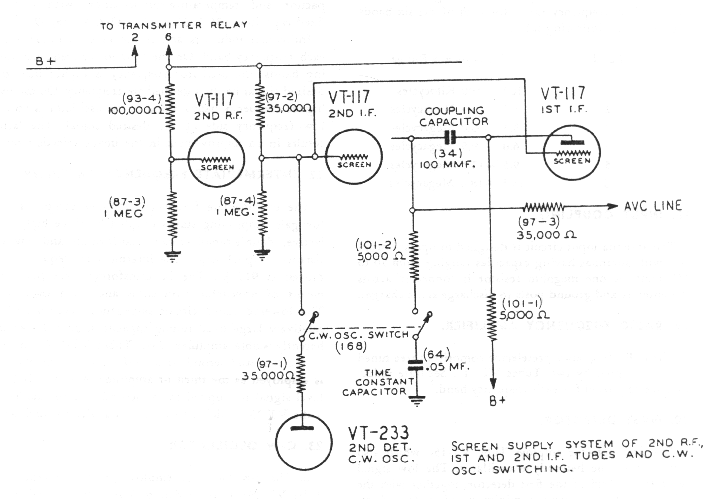
Figure 4 – C-W Oscillator Switching

The effects of ambient temperature variations are minimized by the use of a temperature compensated tuned circuit. The c-w oscillator operates at an extremely low level, minimizing harmonics and stray oscillator pickup. The output is capacitively coupled to the plate circuit of the second amplifier tube by a twisted wire capacitor. Amplification by the third i-f amplifier stage, the gain of which is not controlled either manually or by a-v-c, provides sufficient output from the c-w oscillator to the diode detector. This value of oscillator output is somewhat below the level at which the a-v-c operates, thus permitting the use of automatic volume control even for c-w reception.
b. C-W oscillator switch 168 in the ON position supplies the oscillator plate voltage and increases the a-v-c time constant by connecting the additional capacitor 64. Switch 168 supplies the oscillator plate voltage by connecting to the screen grids of the first and second i-f tubes. The same switching shunts resistor 101-2 across plate resistor lOl-1, which drops the gain in the first i-f tube to a value that reduces the sensitivity by an amount sufficient to keep the overall set noise essentially constant.
24. CRYSTAL BAND-PASS FILTER.
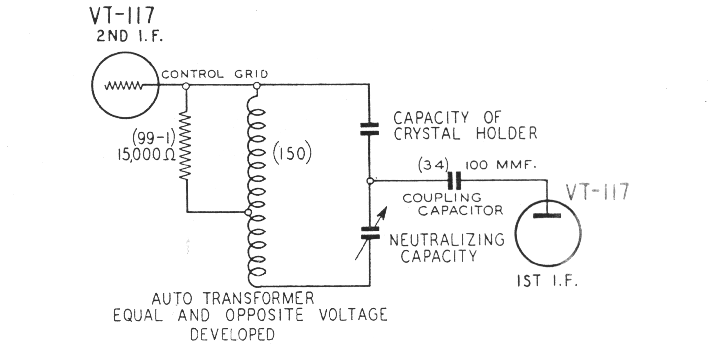
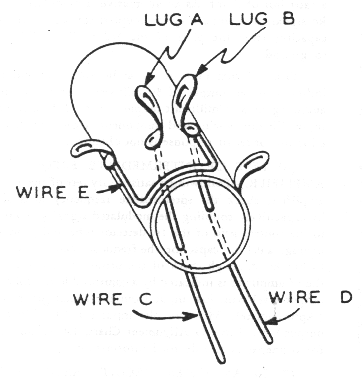
Additional selectivity is available by the use of the i-f crystal filter following the first i-f amplifier tube. Of interest in connection with this filter is the bridge circuit composed of auto transformer 150, a neutralizing capacitor and the capacity of the crystal holder. See Figure 5. Undesired signals transmitted through the capacity of the crystal holder to the grid of the second i-f tube are neutralized by an opposite voltage developed in the auto transformer, and made equal to the undesired grid voltage by the neutralizing capacitor. The crystal filter may be switched in or out of the circuit by the crystal "Out-In' switch 167 which is actuated from the front panel. The filter bandwidth is adjusted by the neutralizing capacitor. See Figure 5. This capacitor consists of two wires and two lugs extending from the neutralizing coil. See Figure 11. For adjustment, see Paragraph 34e(10).

Figure 5 – Crystal Filter Circuit

25. SECOND DETECTOR.
Tube VT-233 also functions as the second detector. A relatively high level signal is supplied by the third i-f amplifier to the diodes of this tube. One diode functions as the signal linear detector while the other diode is capacity coupled and provides high level, delayed a-v-c control bias.
26. OUTPUT.
a. DESCRIPTION.
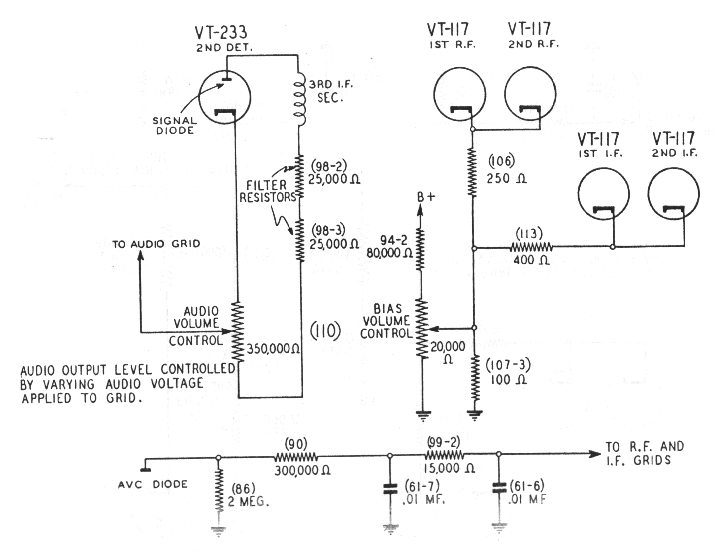
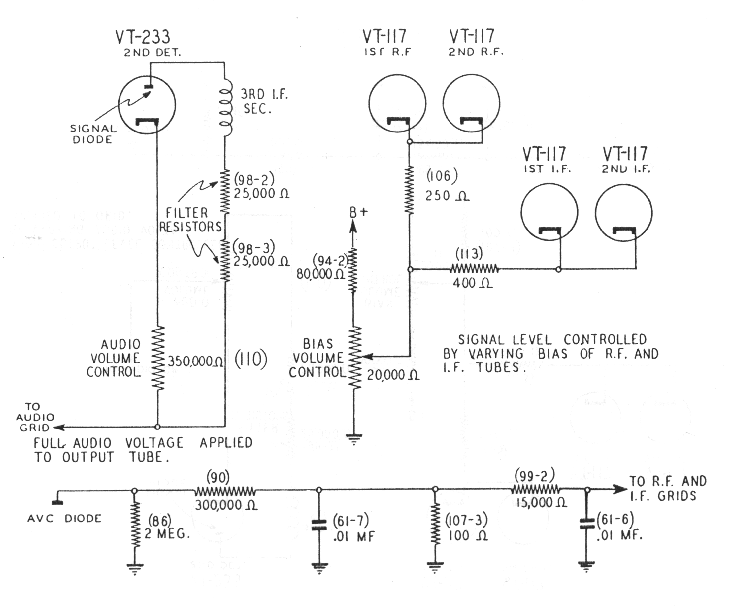
The high level signal diode supplies audio output for driving output Tube VT-152 without additional audio amplification. The design choice of three i-f amplifier stages and high level detection results in a number of operating advantages. The high level detection is relatively free from distortion due to avoiding the characteristic curvature at the lower end of the diode curve. The direct drive of the of the output tube from the diode detector simplifies the dynamotor ripple filtering and eliminates possible microphonics resulting from high audio amplification. The high diode level further provides relatively high bias voltage insuring an unusually flat automatic volume control characteristic with the desired time delay. The dual volume control Il0 comprises the 350,000-ohm audio control potentiometer and the 20,000-ohm bias control potentiometer. The audio volume control functions only with switch 169 in the a-v-c position and in this position it permits the desired adjustment of the audio level to the output tube and load. See Figure 6. The bias volume control also varies to some extent the r-f and i-f tube bias. For manual volume control with switch 169 in the m-v-c position, the bias volume control becomes the active control operating on the cathode bias of the first and second r-f and the first and second i-f amplifier tubes. These potentiometers provide a smooth variation of sensitivity.
b. CONSTANT INTERNAL RECEIVER NOISE.
The flat gain characteristics of the r-f and detector coils insures a uniform noise level over the bands. This is obtained by a combination of inductive and capacitive coupling in the coils.
27. DYNAMOTOR DM-28-(*).
The dynamotor and associated r-f filter circuits are assembled in one unit (Ref. 400) which supplies all of the high voltage direct current required for the operation of the receiver. In addition, a maximum of 20 milliamperes at approximately 200 volts d-c is available at contacts 2 and 5 on the connector plug at the rear of the receiver for the operation of external accessory equipment.

TABLE A – CHARACTERISTICS OF TUBES, LAMPS AND FUSE

TUBE CHARACTERISTICS

Tube Type

RMA Equivalent

Heater

Volts/Amps

Plate

Volts

Screen Volts

Grid Volts

Plate Ma.

Screen Ma.

Mu

Plate Resistance

Transconductance Micromhos

VT-116

6SJ7

6.3/0.3

250

100

-3.0

3.0

0.8

2500

1,500,000

1650

VT-117

6SK7

6.3/0.3

250

100

-3.0

9.2

2.4

1600

800,000

2000

VT-150

6SA7

6.3/0.3

250

100

-2.0

3.4

8.0


800,000


VT-162

6K6

6.3/0.4

250

250

-18.0

32.0

5.5

150

68,000

2200

VT-233

6SR7

6.3/0.3

250


-9.9

9.5


16

8,500

1900

DIAL LAMPS

Type

RMA Equivalent

Volts

Amps.

LM-27

No. 44

6.3

0.25

FUSE

Type

Volts

Amps.

FU-35

25

5.0

Figure 6 – AVC Connections

Figure 7 – MVC Connections

V. MAINTENANCE

NOTE

A standard signal generator, a phantom antenna, a Test Set 1-56-A and other like equipment should be used when servicing and aligning Radio Receiver BC-348-(*)
28. INSPECTION.
a. DAILY.--Turn on receiver. Check dial lamps. Check for operation on all bands with the c-w oscillator "ON". This test can be made by observing the noise level with the volume control at maximum.
b. TWENTY HOURS.--Repeat above. Check antenna, ground and cable connections for effects of vibration.
c. FORTY HOURS.--Repeat above. Check all dial lamps and vacuum tubes with Model.685 Tube Checker in Test Set 1-56-A.
d. MAJOR OVERHAUL.--Repeat above. Inspect and replace dynamotor brushes if necessary. Lubricate dial and tuning capacitor drive mechanism. Check dynamotor and tube socket voltages as described, in Paragraphs 34e(1) and 34h(I.).
29. DYNAMOTOR SERVICE ANDMAINTENANCE.
a. REMOVAL FROM CHASSIS.
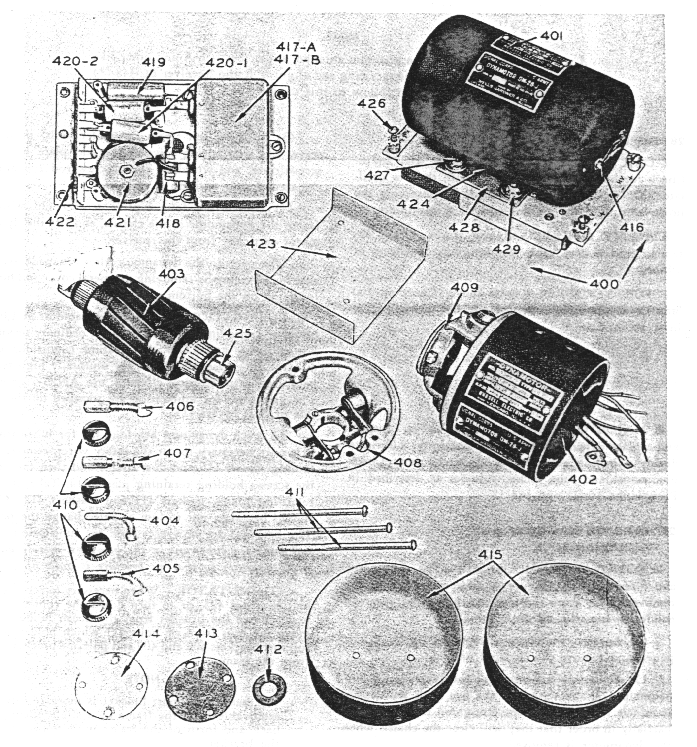
The dynamotor and filter assembly (Figure 8, reference 400) may be removed easily from the receiver chassis by repeating the following steps in the order given:
(1) Loosen two thumbscrews 299 on the front panel, and remove the chassis from the cabinet.
(2) Loosen the five screws on the dynamotor terminal strip 422, and withdraw the five leads with spade terminals from under them. Retighten the five screws partially in order that they will clear the chassis when the dynamotor is removed.
(3) Push the left (from front of chassis) thumbscrew rod stop spring towards the end plate with a screwdriver, and withdraw thumbscrew rod 2~) until the second stop position is reached.
(4) Loosen the four captive screws 426 which fasten the dynamotor to the chassis, and lift the dynamotor vertically from the receiver.
The parts in the dynamotor filter are made available for servicing by removing the metal cover and fibre insulator on the bottom of the unit.
b. LUBRICATION
Lubricate dynamotor at 1,000 hours or approximately six months of ordinary service. For ordinary and LOW temperature conditions use mineral oil grease AN-G-15. For unusually high temperatures, as in tropical climates, use AN-G-5 grease. The directions for lubrication are stamped on the inside of dust covers 415.
To reach dynamotor bearings 425 for lubrication, it is only necessary to cut the safety wires, remove retaining screws 416 and dust covers and then take out the screws holding retaining plates 414. Take off the retaining plates, gaskets 413 and washers 412. Care should be taken not to lose or interchange the parts The bearings are now accessible for lubrication. Do not pack the lubricant in the bearings, merely add a small quantity so that no pressure is built up.

Figure 8 – Dynamotor, DM-28 (*)

c. COMMUTATOR
When necessary to replace the ball bearings 425, or to turn down the commutators, first remove the brushes from the brush holders. Remove the nuts from tie bolts 411 which hold bearing support brackets 408 and 409 and pull one bracket away from the frame.

NOTE

The bearing support bracket is more readily removable from the frame by a slight tilting back and forth of the frame with respect to the bracket.
Armature 403 and the other bracket support may now be removed from the frame. Examine the brushes to see that they are free from hard spots and are wearing properly. Should hard spots be apparent (they generally cause grooves in the commutator surface), the brush should be replaced and the commutator smoothed down. To smooth down the commutator, rotate it in a lathe and hold a fine grade of sand paper, not coarser than size 0o, preferably either 5/0 or 6/0, against the commutator surface. Do not use emery cloth. All residue of dust, sand and dirt should be wiped away to leave a clean, smooth, polished commutator surface. If air is available, the unit should be cleaned by air pressure. A commutator having a smooth or polished surface should never be sanded or turned down simply because it is discolored and well seasoned. If the commutator is turned down in a lathe, the mica segment separators must be undercut but not more than 1/32".
d. BEARINGS.
In changing ball bearings 425, it will be necessary to use a bearing puller since the shaft is machined closely to the dimension of the ball bearing inner race. Actually, the inner race is a light press fit, and the bearing cannot be removed from the shaft without considerable force. The outer races of the ball bearings are merely snug fits in bearing support brackets 408 and 409, and in the disassembly process it should be easy to remove the bracket from the ball bearings. If the grease slinger becomes bent during removal of the ball bearings, it should be straightened and replaced on the shaft before replacing the bearing.
e. REASSEMBLY.
ReassembIy of the dynamotor is accomplished in substantially the reverse of the disassembly procedure. In replacing the brushes check to see that the + and -- markings on the brushes correspond with those on the brush holder supports, and that the marked side of the brush is towards the top of the dynamotor. Armature 403 must be given a final inspection for free running, cleanliness and absence of grease or oil. Bearing support brackets 408 and 409 should be wiped clean and dry before replacing them on the dynamotor.
TABLE B -- DYNAMOTOR DM-28-(*) RATINGS

INPUT

OUTPUT

Volts

Amperes

Volts

Amperes

24

0.7

215

0.

24

1.1

210

30.

24

1.3

202

60.

28

0.8

258

0.

28

1.1

246

40.

28

1.5

236

75.

f. POWER RATING.
The nominal rating of Dynamotor DM-28-(*) is: Input, 1.3 amperes at 27.9 volts; Output, 70 milliamperes at 224 volts; Regulation, 12 per cent. Average performance data on Dynamotor DM28-(*) is as shown in Table B. (Dynamotor and filter disconnected from receiver and negative high voltage connection made to case of unit.)
30. REMOVAL OF FRONT PANEL.
a. The adjustment of the dial and mask and the servicing of certain parts requires the removal of the front panel.
Remove the chassis from the cabinet and place it on the repair bench with the front facing the repairman. Loosen thumbscrews 253 that hold window frame assembly 252 in place, and remove the window frame. Unsolder the white and black tracer lead running to the left panel light socket 171 and the white lead at the antenna binding post 174-1. Hold the thumbscrew rod stop-springs against the sides of the end plates with I screwdriver, and withdraw thumbscrew rods 299 from the receiver.
Remove knobs 290, 291, 292, 293 and 294, and retaining nuts from all controls except the DIAL LIGHTS control, the handles 295, the felt washer on the tuning shaft and the friction spring 242 under the BEAT FREQ. control. Also remove the retaining nuts and covers 300 on the TEL. jacks and the four bolts and eight screws securing the chassis, dial assembly, and cable clamp to the panel. The panel may now be lifted from the chassis after placing the chassis on its back.
b. The process of replacing the panel on the chassis is the reverse of its removal. However, when the BLAT FREQ. control is replaced, follow the instructions given in Paragraph 34e(9) for the adjustment of the control knob on the shaft.
31. DIAL AND MASK ASSEMBLY.
The dial and mask assembly is fastened to both the front panel and receiver chassis. For service, the entire assembly consisting of dial scale, dial mask, band switch shaft, detent wheel and the drive gears may be removed from the chassis as a unit.
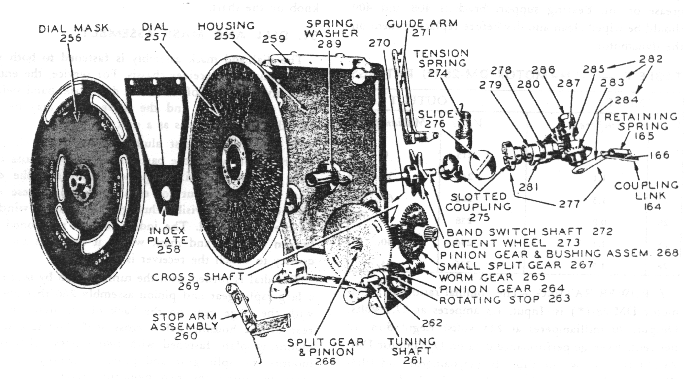
At the front of cast aluminum housing 255, (see Figure 9) on which the parts are mounted, is the dial scale calibrated in six frequency bands and' the dial; mask with the cutout for each band. Both these and the index plate are visible through the glass dial window on the front panel. The index plate is positioned between the dial and mask where it indicates the frequency to which the receiver is tuned.
The dial is turned with the tuning knob by means of a large split gear and pinion assembly 266 that meshes with the large gear on the back of the dial. On the rear of the housing below cross shaft 269 is a metal mounting plate fastened with two screws. This plate mounts the split gear and pinion assembly 266 and after loosening the two mounting screws, the gears may be adjusted to a position that minimizes backlash.
Mounted at the bottom front of the housing is stop arm assembly 260. The right (from front of chassis) end of the arm ends in a hook. The left end has a roller that is held firmly against the outer edge of the dial by a spring. A portion of the outer edge of the dial is cut away so that as the ends of the dial scales are reached, and as the roller on the stop arm follows the dial, the hook on the other end 9f the dial drops and engages the rotating stop 263 mounted on the tuning shaft in front of the pinion gear. This action provides a positive stop at the ends of the tuning ranges on all bands.
The tuning shaft is geared to the tuning capacitor "through worm gear 265, small split gear 267, pinion gear and bushing assembly 268 and the split gear on the tuning capacitor shaft. Pinion gear and bushing assembly 268 is fastened to the cross shaft by means of two set screws. When these screws are loosened, the tuning capacitor is disengaged from the dial and mask assembly, and the relationship between the dial and the tuning capacitor may be adjusted.
Attached near the top of the housing is guide arm assembly 271, which, with the spring 274, positions detent wheel 273. The detent wheel is the six-pointed wheel mounted near the end of the band switch shaft and serves to position the band switches. The slotted coupling on the end of the band switch shaft couples the band switch shaft to bracket and gear assembly 277.
32. SERVICING THE DIAL AND MASK ASSEMBLY.
a. REMOVAL.
Before the dial and mask assembly may be removed for servicing, the front panel must be removed as directed in Paragraph 30a. When this has been done, the dial and mask assembly is held in place by only two hex head mounting screws found on the underside of the chassis. One of these screws is under. the i-f shield plate 231, (see Figure 18) and is accessible only after this plate is removed. After the two mounting screws are removed, the assembly may be lifted from the chassis and serviced.
b. DISASSEMBLY.
To remove dial mask 256, dial 257, dial index plate 258, or the band switch shaft, the taper pin fastening the hub of the mask to the shaft must be removed. While this is being done, be certain to support the shaft so excess strain will not be placed on the center bushing and shaft. After the taper pin has been driven out, the parts may be readily removed.
c. DIAL REPLACEMENT.
Before replacing the dial, be certain that spring washer 289 between the dial hub and the housing is mounted with its convex side towards the dial hub.
The dial is slipped on over the center bushing and the teeth in the dial gear engaged with the teeth of the
small pinion gear. This operation may result in an incorrect stop position. If so, the dial gear will have to be adjusted a tooth at a time until the correct position is reached. The hook on the roller arm should engage the stop on the tuning shaft as the index mark on the low frequency end of the 13.5-18.0 mc scale lines up with the frequency indicator of the index plate. However, the stop arm hook must not start to ,descend until the rotating stop has passed under it on the last revolution of the tuning shaft.
d. STOP ARM REPLACEMENT.
RepIacement of the stop arm may also require a readjustment to obtain the correct stop position. This is done by lengthening or shortening the roller end of the stop arm after loosening the two nuts on the arm.

Figure 9 – Radio Receiver BC-348-J, Dial and Mask Assembly

e. REPLACEMENT OF DIAL AND MASK ASSEMBLY.
When the dial and mask assembly is replaced, the position of coupling 275 on the bracket and gear assembly and coupling 275 on the dial and mask assembly must be such that the position of the dial mask will correspond with the band switch position.
The correct relative positions are obtained when the mask is set to the 200-500 kc position and when coupling link 164 (see Figure 16), connecting the band switch drive mechanism to the band switch, is in a nearly vertical position, even with the front of the output transformer and filter choke unit 155.
f. DIAL CALIBRATION.
Correct dial calibration may be obtained after replacing a dial and mask assembly by adjusting the relation between the dial and tuning capacitor. To do this, loosen the two set screws in pinion gear and bushing assembly 268 until the gear will rotate freely on the shaft. Turn the tuning condenser until it is completely closed (rotor plates meshed with stator plates). Set the band switch for the 13.5-18.0 mc band. Turn the tuning knob until the isolated index mark at the low frequency end of the dial scale is aligned with the frequency indicator on the index plate. Tighten the two set screws in the pinion gear and bushing assembly 268 carefully in order to avoid changing the position of the tuning capacitor, and apply glyptal to the heads of the set screws.
33. REMOVAL OF ANTENNA, R-F, DETECTOR AND OSCILLATOR UNITS
a. When the removal of the top or bottom cover plate does not give sufficient access to the antenna, r-f, or detector units, or when the oscillator unit is serviced, the entire assembly must be removed. This may be accomplished by repeating the following steps in the order given:
(1) Unsolder the leads at the front of the unit.
(2) With the rear of the receiver towards the repairman, remove top covers 225 on the unit to be serviced and the adjacent unit at the left.
(3) Set the band switch control to the 3.5-6.0 mc band.
(4) One end of each retaining spring 165 is hooked over the band switch arm nearest the front of the chassis. Use long nose pliers and lift the ends of the two springs off the arms (for the antenna unit only one spring must be removed). Also lift coupling links 164 over the ends of the arms.
(5) Remove the tie strips on the top of the cans, front 229 and rear 227.
(6) Remove the screws fastening the bottom tie strips 227 and 228 to the unit to be removed.
(7) Remove the mounting screws at the front and rear of the unit.
(8) Carefully lift the unit from the chassis.
b. To replace a unit, reverse the procedure given above. Do not tighten the screws fastening the unit until after the band switch sections have been reconnected and the band switch operated a few times. This will allow the unit to reposition itself.
34. TROUBLE LOCATION AND REMEDY.
a. QUICK CHECK.
Most service men, given a faulty receiver to repair, will seek a clue which will result in a rapid location of the trouble. If the user can be questioned, a helpful answer is often obtained.
A careful visual and mechanical inspection of the chassis and connections is generally one of the first steps. Pulling at the various parts, including resistors, capacitors, wires and solder connections, will often locate a faulty connection.
Inspect parts and wiring for grounds or shorted connections and open circuits. Inspect resistors and coils for charred surfaces or discolorations that indicate an excessive current condition. The odor of overheated insulation often tells the story of overload carried by the conductor.
If nothing is disclosed by the visual and mechanical inspection of the chassis and connections, the tubes may next be checked, since they are often the cause of the faulty operation. This may be done with a tube checker or by replacement with known good tubes.

NOTE

All tubes of a given type supplied with the equipment shall be consumed prior to employment of tubes from general stock.
If the tubes are good, connect the power to the chassis (with latter out of the case) and again move and tap the various parts and wires as a further means of locating opens, shorts and grounds. Hum, squeals, howls, distortion and other audible indications, dead voltage points, etc., may disclose the source of difficulty.
Failure of the quick check to disclose the source of the trouble should be followed by the reading of voltages at socket terminals and other points, continuity resistance measurements, realignment, signal tracing to isolate the faulty stages and replacement of major units as explained in succeeding paragraphs.
b. SENSITIVITY.
The normal sensitivity (number of microvolts input to produce 10 milliwatts output into a 4,000 ohm resistance load) of the receiver is less than 3 microvolts (except on range 1, which is 5 microvolts) when measured as follows:
(1) With the AVC-OFF-MVC switch in the MVC position, the c-w oscillator OFF, the crystal filter OUT and a 4,000 ohm non-inductive resistance as the output load, feed a modulated signal from a signal generator into the receiver through a 100 mmf. dummy antenna. Adjust the output of the signal generator until the receiver output is 10 milliwatts. Turn off the signal generator modulation and adjust the receiver volume control until the noise output level is 2.5 milliwatts. Turn on the modulation and raise the signal generator output until the 10 milliwatt output is again indicated on the output meter.
(2) This sensitivity will, of course, be subject to variation with time due to tube aging, etc. Therefore, it is recommended that no attempt be made to retrim or realign the equipment unless the sensitivity is found to be worse than 7 microvolts with new, average tubes.
The receiver has been carefully adjusted and aligned by the manufacturer before shipment and should maintain these adjustments over reasonably long periods of time. Major adjustments and repairs should be made only in an authorized repair shop equipped with the necessary servicing tools and equipment. All others must refrain from changing any of the adjustments of the radio frequency circuits.

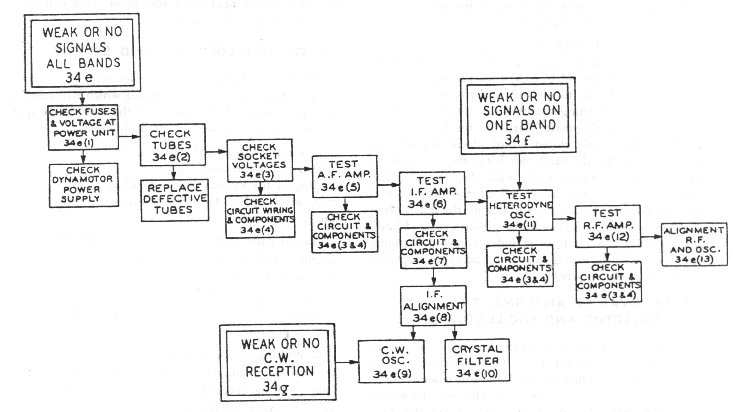
Figure 10 – Trouble Location and Correction Chart

c. TROUBLE LOCATION AND CORRECTION PROCEDURE.
The following is a generalized trouble shooting procedure which may be used if no clue to the trouble source has been found. It has been divided into the following:
Equipment required--See paragraph 34d
Weak or no signals on all bands;
Modulated reception--See paragraph 34e
Weak or no signals on any one band;
Modulated reception--See paragraph 34f
Weak or no signals on all bands;
C-W reception (modulated reception normal)-See paragraph 34g
d. EQUIPMENT REQUIRED.
Few instruments other than those found in a standard set analyzer (Test Set 1-56-A) are required in locating the most probable troubles in this receiver. The individual instruments required are as follows:
(1) A modulated test oscillator (standard signal generator) with a frequency range from 200 to 18,000 kc with provision for calibration accuracy better than 0.1% at aligning frequencies.
(2) *Voltmeter -- 1,000 ohms per volt, ranges: 0-10; 0-100; 0-250; 0-500 volts.
(3) *Continuity tester.
(4) *Out, put meter rectifier type, 0-15 volt, 4,000 ohms.
(5) Microammeter, 0-200 Microamperes.
(6) Audio frequency oscillator.
(7) Headphones.
(8) Adapter FT-211 consisting of an 8-prong octal plug, and an 8-prong octal socket connected together by a short length of 8-conductor cable, to permit use of the Test Set 1-56-A Analyzer on octal tubes.
* Part of Test Set 1-56-A.
e. WEAK OR NO SIGNALS ON ALL BANDS, MODULATED RECEPTION.
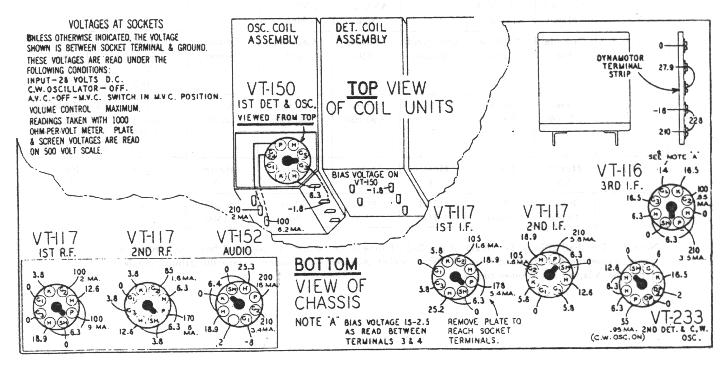
(1) CHECK OF DYNAMOTOR VOLTAGES.--When all signals on all bands are weak or no signals axe heard even when known to be present, check the dynamotor voltages at the dynamotor terminal strip (Figure 12, Socket Voltages). The voltages should approximate the values shown. Conditions of measurements are:
Input voltage 28V; AVC.OFF-MVC switch MVC; Crystal control OUT; C-W Osc. OFF; Volume Control maximum; Load 4,000 ohms non-inductive resistance. If these voltage readings do not approximate the values shown, the fuse should be checked, as well as the dynamotor and filter circuits, wiring and components.
(2) TUBE CHECK.--If the voltages at the dynamotor terminal strip approximate the values given, proceed to check all tubes with the Model 685 tube checker for emission and characteristics or replace all tubes with those of known average characteristics, if this has not been done in the "Quick Check".
(3) CHECK OF SOCKET VOLTAGES.-- If tubes check satisfactorily, or if after replacing with tubes known to be good the sensitivity is still low, proceed to check all tube socket voltages as outlined under Paragraph ~b(1) with Test Set 1-56-A. The average socket voltages for Radio Receiver BC-548-(*) are given in Table C Socket Voltages.
(4) CHECK CIRCUIT WIRING AND COMPONENTS.--If the tube socket voltages do not approximate the values shown in Table C Socket Voltages, the associated circuits and components should be checked for grounds, shorts and similar defects using Test Set 1-56-A, the wiring diagram Figure 30, Table D Resistance Between Socket Terminals and Ground, mad Table E.
(5) TEST OF AUDIO FREQUENCY AMPLIFIER.--After checking socket voltages, circuit wiring and components, proceed to the test of the audio frequency amplifier. This can be checked by capacitively coupling a 400 cycle voltage of approximately 2 volts R.M.S. from the detector signal diode to ground a capacitor of .5 inf. As an alternative, a modulated 915 kc signal of 2 volts may be coupled through a .l mf capacitor from the plate of the 3rd i-f Tube vt-ll6 to ground.
Proper functioning of the audio amplifier will be indicated by an output of 50 milliwatts for the 2 volt audio signal or 1 milliwatt output for the 915 kc signal input. Circuits, wiring and components should be checked if this order of response is not obtained.
(6) TEST OF INTERMEDIATE FREQUENCY AMPLIFIER.--Following a satisfactory test of the audio amplifier, check the intermediate frequency amplifier by capacitively coupling the modulated signal generator to the control grid of the 1st detector tube and ground, through a 0.1 mf. capacitor, the frequency being adjusted to 915 kc. A rough check of the proper functioning of the i-f amplifier is indicated by a comfortable headphone output level with low input from the signal generator. (Approximately 35 microvolts input for 10 milliwatts output.) See Table G Alignment Chart, 1st i-f column, for connections and detailed information.
(7) I-F AMPLIFIER CIRCUIT CHECK. -- If the i-f amplifier does not respond as above or lacks sensitivity, a progressive check, stage-by-stage, should be made to do this, couple the signal generator to the 3rd i-f tube control grid through a 0.1 mf capacitor. Set the controls and make the connections as described in Table G, Alignment Chart, 3rd i-f column. If the receiver is in proper order from the output to this stage, a signal of 60,000 microvolts from the signal generator will provide a 10 milliwatt output level. Then couple the signal generator to the 2nd i-f and 1st detector tubes as explained in the next two columns in the alignment chart, and check the input signal required for standard output. A faulty stage should be carefully checked for shorts, grounds and faulty components using the wiring diagrams in Section V and Resistance Tables D and E.
(8) ALIGNMENT OF I-F AMPLIFIER.—When all stages have been tested, the i-f amplifier alignment may be checked and realigning done if necessary. This is done by following the procedure as given in the 1st, 2nd and 3rd i-f columns in Table G Alignment Chart.
(9) CHECK AND ALIGNMENT OF C-W OSCILLATOR.-- The c-w oscillator is checked and adjusted after setting the receiver controls as instructed for i-f alignment in Table G Alignment Chart. A 915 kc signal of about 30 microvolts is fed into the control grid of the 1st detector. Remove the modulation from the signal generator. Turn the c-w oscillator to the ON position. Rotate the beat frequency knob to zero beat position. The arrow on this knob should be vertical and pointing upward. If it is not, loosen the set screws and set this knob properly. If no beat note is heard, check the c-w oscillator circuit for grounds, shorts and defective components using Test Set 1-56-A and the readings given in Table C Socket Voltages, and Resistance Tables D and E.

Figure 11 – Crystal Filter Coil

(10) NEUTRALIZING THE CRYSTAL CIRCUIT.--AII crystal circuits are properly neutralized at the factory before being shipped. Ordinarily, reneutralizing is not required unless the neutralizing coil and capacitor (Ref. 150) or crystal and switch assembly (Ref. 160 and 167) have been replaced, or unless the crystal circuit appears to be excessively broad. If neutralizing is necessary it may be done as follows:
Disconnect the output meter and put an 0-200 microammeter in the line from the volume control (rear section) to the second detector cathode. This is most easily done by unsoldering the lead at the volume control lug.
Set all receiver and signal generator controls as for i-f alignment. Turn the crystal control to the IN position. Rotate the signal generator tuning knob slightly until the crystal peak is located, observing the microarnmeter. Tune carefully to the exact peak. Note the frequency of the generator. This will be the frequency of the crystal, which should not be more than 1.3 kc above or below 915 kc.
Detune the signal generator 10 kc below the crystal frequency. For example, if the crystal frequency is 916.2 kc, tune the signal generator to 906.2 kc.
Turn modulation of signal generator off and increase the output to about 1 volt.
Extending from the neutralizing coil are two lugs A and B and two corresponding wires C and D. See Figure 11.
Extending from lug B is a wire E passing around the edge of the coil form. Increase and decrease the capacity between wires C and D by bending them closer to each other and farther apart until the micrometer reading is at a minimum. In cases where low capacity is required, cut off the wires C and D. If extreme low capacity is required, cut off lugs A and B. Also move wire E away from lug A.
(11) CHECK OF HETERODYNE OSCILLATOR. Having checked the functioning of the i-f and audio amplifiers, if signals are not heard on any band, the heterodyne oscillator should be checked for oscillation.
This can be done by coupling a 915 kc signal through a .l mf. capacitor to the control grid of the 1st detector. Short the stator of the oscillator section of the tuning capacitor (Section I-D) to ground. The output should go up. This indicates that the oscillator was functioning satisfactorily. Do this on all bands.
(12) R-F AMPLIFIER AND HETERODYNE OSCILLATOR. -- Having completed the test and alignment of the audio amplifier, i-f amplifier and heterodyne oscillator, test the r-f amplifier as follows:
Turn the band switch to band No. 1. Set the receiver and generator controls as described in Table G Alignment Chart, No. 1 band column, but use a 0.1 mf. dummy antenna and make the antenna connection to the control grid of the 1st detector tube. Turn the tuning control until the test signal is picked up and carefully tuned in. The receiver dial should indicate the same frequency as the signal generator. If there is more than .75 per cent variation, the oscillator must be realigned as described below.
Proceed to check the r-f amplifier, stage-by-stage, working towards the antenna. Couple the signal generator through the 0.1 mf. dummy antenna to the control grids of the 2nd r-f tube and the 1st r-f tube. Then, using a dummy antenna of 100 mmf, couple the signal generator to the antenna binding post. At each stage, the receiver output should increase substantially indicating the stage gain. If there is no gain, the stage should be checked for defective components, shorts and grounds, using Tables C, D and E.
Do this on all bands.
(13) R-F AMPLIFIER AND HETERODYNE OSCILLATOR ALIGNMENT.-- Instructions are given in Table G Alignment Chart for completely aligning the r-f amplifier and heterodyne oscillator circuits. Start with number 1 band column and continue with all columns to the right.
f. WEAK OR NO SIGNALS ON ANY ONE BAND, MODULATED RECEPTION.
The condition of satisfactory reception on several bands and weak or no signals on one or more bands indicates the correct functioning of the i-f and a-f amplifiers, and requires checking only the r-f amplifier and heterodyne oscillator for the defective band or bands. The procedure outlined in Paragraphs 34e(11) to 34e(13) should be followed for the defective band or bands.
g. WEAK OR NO SIGNALS ON ALL BANDS C-W RECEPTION (MODULATED RECEPTION NORMAL).
Weak or no signals on all bands for c-w reception, with satisfactory modulated signal reception, requires testing and alignment of the c-w oscillator. Proceed as outlined in Paragraphs 34e(9) and 34e(10).
h. MEASUREMENTS WITH TEST SET 1-56-A.
The tables that follow show voltage and resistance measurements made from the chassis ground to the tube socket terminals and other important points. These measurements were made with Model 665 Analyzer and other equipment contained in Test Set 1-56-A. They are typical readings that will be approximated in Signal Corps Repair Shops when using this equipment on receivers in good operating condition. When faulty operation of Radio Receiver BC-348-(*) is encountered, see that all plugs are firmly seated and check carefully the cables and plugs with Model 564 Voltohmmeter as instructed on page 11 of the instruction book for Test Set 1-56-A under "Detailed Tests on Radio Sets." If the trouble is not located in the cables, remove the chassis and check the tubes with Model 685, Tube Tester as instructed on page 11 of the test set instructions. After this is done, proceed with the voltage and continuity measurements described below:
(1) VOLTAGE AND CURRENT MEASUREMENTS. -- Instructions are given on page 12 of the test set instruction book for making voltage and current measurements with Model 665 Analyzer and Model 666 Socket Selector. Latest instructions which include the use of the octal socket adapter are necessary. These instructions should be followed for measurements on all except the second r-f tube.

NOTE

When making measurements at the second r-f tube, the flexible lead on the orange adapter plug must be removed from the pin jack marked GND and inserted in the outer No. 3 jack, as the shield is not grounded.
Great care must be exercised when inserting the analyzer plug into the sockets on the r-f tube shelf in order to avoid damage to the prongs, as the shelf is mounted at an angle that just permits the insertion of the plug.
PROCEDURE
1. With the chassis removed from the cabinet and power supplied to the receiver through the connector plug, place the controls in the positions designated on the voltage table
2. Set up the 665 Analyzer and the 666 Socket Selector for making readings on metal tubes as instructed on page 12 of the test set instructions. (See note above for second r-f tube setup.)
3. Throw the analyzer AC-DC switch to DC and the VOLTS-MA-OHMS switch to VOLTS-MA.
4. Use the voltmeter ranges indicated on the voltage table and proceed to make the desired readings between the chassis ground and the terminals given on the voltage chart.
When using Model 666 Socket Selector to read voltages, the capacity between the leads in the cable may cause oscillations which will affect voltages and currents. In the case of a voltage that is found to read considerably different from that shown on the table, replace the tube in the receiver and read the voltage at the socket terminal with test prods before attempting to locate the source of the incorrect voltage.
(2) RESISTANCE AND CONTINUITY MEASUREMENTS. -- Resistance and continuity measurements are to be made with Model 665 Analyzer as instructed on page 12 of test set instructions.
The tables that follow show resistance measurements made from the chassis ground to the tube socket terminals and other important points that are easily accessible. These measurements may be made with the test prods at the terminals, or in the case of tube sockets, Model 666 Socket Selector may be used as instructed in paragraph 34h(1).
Whenever possible, select an ohmmeter range that will allow the readings to be made on the 0 to 60 section of the ohmmeter scale, as greater accuracy is obtained over this portion of the scale.
Always set the ohmmeter to zero ohms each time a different scale is used, or before making the initial measurements. To do this, short together the two test prods and turn the "battery adjustment" knob until the meter reads exactly zero ohms. If the meter cannot be adjusted to zero, the battery in the analyzer will have to be changed. For instructions, see the section on battery replacement under "Maintenance" on page 42 of the test set instruction book.
PROCEDURE
1. With the chassis removed from the cabinet and no power supplied to the receiver, place the controls in the positions designated on the resistance and continuity chart.
2. Set up the Model 665 Analyzer and the Model 666 Socket Selector, if used, as instructed on page 12 of the test set instructions.
3. Throw the analyzer AC-DC switch to DC and VOLTS-MA-OHMS switch to OHMS.
4. Proceed to make the desired readings between chassis ground and terminals as indicated on the resistance and continuity tables.
i. FAILURE OF DIAL LIGHTS.
The two dial lamps are connected in series; hence the lack of dial illumination does not indicate failure of both lamps. Removal of the dial light housing gives ready access to the lamps.

TABLE C -- TUBE SOCKET VOLTAGE CHART

THE VOLTAGES ARE READ BETWEEN THE SOCKET TERMINAL AND GROUND UNDER THE
FOLLOWING CONDITIONS UNLESS OTHERWISE STATED:
Headphones, Antenna and Ground disconnected. AVC-OFF-MVC Switch in MVC position. Band Switch set for Band No. 1, 200-500 kc. All readings taken with 1000 ohm per volt meter. Tuning Control set at 200 kc. Plate and Screen voltages read on 500 volt scale. Other voltages read on appropriate scales. Crystal Control OUT position. C-W Oscillator OFF position. Volume Control maximum. Dial Light Control maximum. See last paragraph in 34b(1) regarding possibilities of fictitious voltages when using socket analyzer.

Socket, terminal or Block No.

6SK7 VT-117 1st R-F

6SK7 VT-117 2st R-F

6SA7 VT-150 1st Det.

6SK7 VT-117 1st I-F

6SK7 VT-117 2nd I-F

6SJ7 VT-116 3rd I-F

6SR7 VT-233 2nd Det. C-W Osc.

6K6 VT-152 Audio

1.

Shell

0 V.

Shell

8 V.

Note A

Shell

0 V.

Shell

0 V.

Shell

0 V.

Shell

0 V.

Shell

0 V.

0 V.

2.

Heater

18.9 V

Heater 12.6 V.

Heater

0 V.

Heater

25.2 V.

Heater

12.6 V.

Heater

6.3 V.

Grid

6 V.

Note D

Heater

25.3 V.

3.

Sup

0 V.

Sup.

3.8 V.

Plate

210 V.

2 Ma.

Sup.

5.8 V.

Sup.

5.8 V.

Sup.

16.5 V.

Cathode

16.5 V

Plate

200 V.

18 Ma.

4.

Grid

0 V.

Grid

0 V.

Screen

100 V.

Note C

6.2 Ma.

Grid

0 V.

Grid

0 V.

Grid

14 V.

Diode

2 V.

Screen

210 V.

3.4 Ma.

5.

Cathode

3.8 V.

Cathode

3.8 V.

Osc Grid

-.4 V

Cathode

5.8 V.

Cathode

5.8 V.

Cathode

16.5 V.

Diode

0 V.

Grid

-8 V.

Note E

6.

Screen

100 V.

2 Ma.

Screen

83 V.

1.6 Ma.

Cathode

0 V.

Screen

105 V.

1.6 Ma.

Screen

105 V.

1.6 Ma.

Screen

100 V.

.85 Ma.

Plate

55 V.

Note B

(C-W Osc. ON)

.95 Ma

Tie Terminal

.2 V.

7.

Heater

12.6 V

Heater

6.3 V

Heater

6.3 V

Heater

18.9 V

Heater

18.9 V

Heater

0 V

Heater

6.3 V

Heater

18.9 V

8.

Plate

100 V.

9 Ma.

Plate

170 V.

6 Ma.

Grid

-1.8 V.

Plate

185 V.

5.4 Ma.

Plate

210 V.

5.8 Ma.

Plate

210 V.

3.5 Ma.

NOTE F

Heater

12.6 V.

Cathode

0 V.

Note A--The shell (No. I Terminal) of the 2nd r-f tube is not at ground potential but is connected to the cathode. For that reason the flexible Lead from the Octal Socket Adapter is not inserted into the ground pin jack but is inserted into the Adapter No. 3 outer pin jack.
Note B--55 volts read at socket terminal. 45 volts read with adapter plug--see last paragraph of 34h(1).
Note C---60 volts read with analyzer. See Note B.
Note D---As read on 50-volt scale.
Note E--As read on 500-volt scale.
Note F---450 volts read with analyzer. See Note B.

TABLE D -- RESISTANCES BETWEEN SOCKET TERMINALS AND GROUND

RESISTANCE READINGS ARE MADE UNDER THE FOLLOWING CONDITIONS:
Power Plug, Headphones, Antenna and Ground Disconnected. C-W Osc. OFF position. Volume Control maximum. Tubes cold and left in socket to complete series heater connections. Dial Light Control maximum.AVC-OFF-M-VC Switch MVC position (except for values preceded by AVC which are read in that position). Band Switch set for Band No. 1, 200-500 kc. Tuning Control set at 200 kc. Crystal Control OUT position. Unless otherwise specified, all resistances shown in ohms.

Socket, terminal or Block No.

6SK7 VT-117 1st R-F

6SK7 VT-117 2st R-F

6SA7 VT-150 1st Det.

6SK7 VT-117 1st I-F

6SK7 VT-117 2nd I-F

6SJ7 VT-116 3rd I-F

6SR7 VT-233 2nd Det. C-W Osc.

6K6

VT-152 Audio

1.

Shell

0.

Shell

250

Note A

Shell

0

Shell

0

Shell

0

Shell

0

Shell

0

0

2.

Heater

6.5

Heater 5.5.

Heater

0

Heater

6.5.

Heater

5.5.

Heater

3.

Grid

100,000

Heater

6.5

3.

Sup

0

Sup.

250

Plate

520

Sup.

420

Sup.

420

Sup.

4000

Cathode

4000

Plate

1200

4.

Grid

1 Meg AVC 3.3 Meg

Grid

90,000 AVC 2.4 Meg

Screen

20,000

Grid

15,000 AVC 2.3 Meg

Grid

15,000 AVC 2.3 Meg.

Grid

3500

Diode

400,000

Screen

900.

5.

Cathode

250

Cathode

250

Osc 80,000

Cathode

420

Cathode

420

Cathode

4000

Diode

260,000 AVC 2 Meg

Grid

1.1 Meg

6.

Screen

15,000

Screen

500,000

Cathode

1.2

Screen

500,000

Screen

500,000

Screen

120,000.

Plate

500,000 5 Meg Osc ON

Tie Terminal

.5

7.

Heater

5.5

Heater

4

Heater

4

Heater

6.5

Heater

6.5

Heater

0

Heater

3

Heater

6.5

8.

Plate

15,000

Plate

10,000

Grid

1 Meg

Plate

5500

Plate

500

Plate

1500

Heater

5.5

Cathode

0

Note A--The shell (No. l Terminal) of the 2nd r-f tube is not at ground potential but is connected to the cathode. For that reason the flexible Lead from the Octal Socket Adapter is not inserted into the ground pin jack but is inserted into the Adapter No. 3 outer pin jack.

TABLE E -- ADDITIONAL POINTS TO MAKE CONTINUITY

RESISTANCE READINGS TO GROUND

RESISTANCE READINGS MADE UNDER THE SAME CONDITIONS
AS FOR TUBE SOCKET READINGS

POWER CONNECTOR

(175)

OUTPUT TRANSFORMER

And CHOKE (155-A and B)

DYNAMOTOR

TERMINAL STRIP

Terminal

Numbers

On Connector

Resistance

Terminal

Numbers

On Unit

Resistance

Readings from low

Voltage to High

Voltage end

1.

150 ohms

1.

16 ohms

0

2.

500 ohms

2.

150 ohms

1.5 ohms Note A

3.

1.5 ohms Note A

3.

500 ohms

1.5 ohms Note A

4.

1.5 ohms Note A

4.

1200 ohms

270 ohms

5.

0

5.

25 ohms

500 ohms

6.

500,000 ohms

6.

270 ohms


7.

0


8.

0


Note A-This reading may be found to vary and may be as high as 11 ohms. This condition is normal and jarring the dynamotor will often return the reading to approximately the value shown.

Figure 12 – Socket Voltages

TABLE F -- COIL CHARACTERISTICS

Inductance Readings Given in Microhenries. All D.C. Resistance Readings Given in Ohms. Inductance Measurements Made at 1,000 Cycles. Resistance Readings Within +/-10%. With Coil Removed from Shield. "Q" Readings Made With Coil Removed From Shield. Primary Inductance Readings Within +/-5%. "Q" Readings Within +/-20%. Secondary Inductance Readings Within +/-2%..

Band

No.

Coil

Ref. No.

Inductance

D.C. Resistance

Q

Frequency for

"Q" Measurement


Pri.

Sec.

Pri.

Sec.

Pri.

Sec.


ANTENNA UNIT


1

120

1348.7

1864.7

125

16.5


88

500 KC(5)

2

121

298.7

27.8

13.8

0.75


145

1.5 MC(5)

3

122

39.0

4.6

4.5

0.18


122

6.0 MC(5)

4

123

14.5

1.1

3.0

0.11


157

9.5 MC(5)

5

124

10.2

0.6

2.4

0.03


139

13.5 MC(5)

6

125

3.0

0.1

1.4

0.02


173

18.0 MC(5)

Band

No.

Coil

Ref. No.

Inductance

D.C. Resistance

Q

Frequency for

"Q" Measurement


Pri.

Sec.

Pri.

Sec.

Pri.

Sec.


R-F UNIT


1

126

(7)

2439.7

61.5


74

500 KC(5)

2

127

(7)

41.6

0.49

3.1


99

1.5 MC(5)

3

128

(7)

7.0

0.53

0.2


161

6.0 MC(5)

4

129

(7)

2.0

0.52

0.1


162

9.5 MC(5)

5

130

(7)

1.2

0.52

0.04


217

13.5 MC(5)

6

131

(7)

0.3

0.75

0.03


220

18.0 MC(5)

Band

No.

Coil

Ref. No.

Inductance

D.C. Resistance

Q

Frequency for

"Q" Measurement


Pri.

Sec.

Pri.

Sec.

Pri.

Sec.


DETECTOR UNIT


1

132

(7)

2433.7

61.5


74

500 KC(5)

2

133

(7)

41.6

0.49

3.1


99

1.5 MC(5)

3

134

(7)

7.0

0.53

0.2


161

6.0 MC(5)

4

135

(7)

2.0

0.52

0.1


162

9.5 MC(5)

5

136

(7)

1.2

0.52

0.04


217

13.5 MC(5)

6

137

(7)

0.3

0.75

0.03


220

18.0 MC(5)

Band

No.

Coil

Ref. No.

Inductance

D.C. Resistance

Q

Frequency for

"Q" Measurement


Pri.

Sec.

Pri.

Sec.

Pri.

Sec.


OSCILLATOR UNIT


1

138

(7)

346.9

1.2

6.3


96

1.0 MC

2

139

(7)

25.8

0.7

1.1


152

12.5 MC

3

140

(7)

5.3

0.54

0.24


114

7.0 MC

4

141

(7)

1.6

0.9

0.07


156

10.5 MC

5

142

(7)

1.5

0.4

0.06


160

12.5 MC

6

143

(7)

0.4

0.76

0.03


179

17.0 MC

Band

No.

Coil

Ref. No.

Inductance

D.C. Resistance

Q

Frequency for

"Q" Measurement


Pri.

Sec.

Pri.

Sec.

Pri.

Sec.


I-F COILS


1st I-F

147

120(1)

120(1)

1.5(2)

1.5(2)

129

128

915 KC(3)

2nd I-F

148

120(1)

120(1)

1.5(2)

1.5(2)

129

128

915 KC(3)

3rd I-F

149

120(1)

242(1)

1.5(2)

5.0(2)

128

112

915 KC(3)

Band

No.

Coil

Ref. No.

Inductance

D.C. Resistance

Q

Frequency for

"Q" Measurement


Pri.

Sec.

Pri.

Sec.

Pri.

Sec.


MISCELLANEOUS COILS


Xtal Neut

150

2.03


52.75


56(6)

400 KC

C-W Osc.

151

1.9(1)

125.5(1)

0.21(2)

1.74(2)


77

915 KC(3)

I-F Trap

152

60.9

2.3


74

915 KC

Choke

420

466.2(4)

12.0


Choke

421

79.1(4)

0.15


Coil in can and resonated to 915 KC. Readings made at 1,000 cycles.
+/-5%.
Reading made with coil in can, tuning capacitor removed and replaced with Q Meter capacity of equal value and iron cores adjusted until circuit resonates at 915 KC.
+/-10%.
Primary shorted.
Measured across total inductance.
Coils 126, 132 and 138 have no primaries. Other primary inductances too small for practical measurement.

TABLE G -- ALIGNMENT CHART


Follow alignment in order from left to right. Start with 3rd I-F adjustment in first column, then 2nd I-F, etc. Connect signal generator to ground post of receiver using a short heavy lead. Allow receiver and signal generator to heat up for several minutes.

RECEIVER CONTROLS


3rd I.F.

2nd I.F.

1st I.F.

No. 1 Band


C.W. Osc.

OFF

OFF

OFF

OFF


Crystal

OUT

OUT

OUT

OUT


AVC-OFF-MVC

MVC

MVC

MVC

MVC


Volume

Maximum

Maximum

Maximum

Maximum


Band Sw. Setting

No. 2 Band

1.5-3.5 Mc

No. 2 Band

1.5-3.5 Mc

No. 2 Band

1.5-3.5 Mc

No. 1 Band

200-500 kc


Tuning Control

Position

1.5 Mc

1.5 Mc

1.5 Mc

470 kc

SIGNAL GENERATOR

Antenna Connections

3rd I.F. Tube

VT-116 Control Grid Socket Terminal No. 4

2nd I.F. Tube

VT-117 Control

Grid Socket

Terminal No. 4

1st Det. Tube

VT-150 Control

Grid External

Terminal

Antenna Post


Dummy Ant.

0.1 MFD

0.1 MFD

0.1 MFD

100 MMF


Frequency Setting

915 kc. +/-1000

Cycles or less

915 kc. +/-1000

Cycles or less

915 kc. +/-1000

Cycles or less

470 kc

PROCEDURE

Sensitivity

60,000 Microvolts

2,100 Microvolts

35 Microvolts

9 Microvolts

See Note A


Trimmers Adjusted

3rd I.F.

Tuning Cores

See Fig. 13

2nd I.F.

Tuning Cores

See Fig. 13

1st I.F.

Tuning Cores

See Fig. 13

No. 1 Trimmers on Osc. Det. R.F. and Antenna Units See Fig. 13


Procedure

Increase Sig. Gen to about 1 volt. Adjust 3'rd I.F. Tuning Core screws, first top screw and then bottom. Adjust top and bottom screws again and then a third time to maximum output.

Decrease input from Sig. Gen. to 10 milliwatt output level. Adjust 2nd I.F. Tuning Core screws, top screw first, then bottom. Adjust top and bottom screws again, and then a third time to maximum output.

Decrease input from Sig. Gen. to 10 milliwatt output level. Adjust 1st I.F. Tuning Core screws, top screw first, and then bottom. Adjust top and bottom screws again, and then a third time to maximum output.

Adjust No. 1 Trimmer on Osc. Unit to max. output. Then adjust Trimmers on Det., R.F., and Antenna Units, in that order to maximum output, and decrease signal as required to maintain 10 milliwatts output. Repeat above.

NEUTRALIZING THE CRYSTAL CIRCUIT
Neutralizing of the crystal circuit is not required in ordinary alignment procedure. It should not be attempted unless one of the neutralizing circuit elements as mentioned in Paragraph 34e(10) have been replaced or unless the tuning band of the crystal circuit appears to be excessively wide.
C-W OSCILLATOR CHECK
The C-W Oscillator adjustment is likewise not required in ordinary alignment procedure. It may be done as explained in Paragraph 34e(9).

215 kc.

Osc. Padder

No. 2 Band

No. 3 Band

No. 4 Band

No. 5 Band

No. 6 Band

OFF

OFF

OFF

OFF

OFF

OFF

OUT

OUT

OUT

OUT

OUT

OUT

MVC

MVC

MVC

MVC

MVC

MVC

Maximum

Maximum

Maximum

Maximum

Maximum

Maximum

No. 1 Band

200-500 kc.

No. 2 Band

1.5-3.5 Mc

No. 3 Band

3.5-6 Mc

No. 4 Band

6-9.5 Mc

No. 5 Band

9.5-13.5 Mc

No. 6 Band

13.5-18 Mc

215 kc.

3.3 Mc

5.7 Mc

9.0 Mc

13.0 Mc

17.3 Mc

Antenna Post

Antenna Post

Antenna Post

Antenna Post

Antenna Post

Antenna Post

100 MMF

100 MMF

100 MMF

100 MMF

100 MMF

100 MMF

Shut Off Signal

Generator See Note B

3.3 Mc

5.7 Mc

9.0 Mc

13.0 Mc

17.3 Mc


9 Microvolts

See Note A

9 Microvolts

See Note A

9 Microvolts

See Note A

9 Microvolts

See Note A

9 Microvolts

See Note A

215 kc. Oscillator Padder

See Fig. 13

No. 2 Trimmers on Osc. Det. R.F. and Antenna

See Fig. 13

No. 3 Trimmers on Osc. Det. R.F. and Antenna

See Fig. 13

No. 4 Trimmers on Osc. Det. R.F. and Antenna

See Fig. 13

No. 5 Trimmers on Osc. Det. R.F. and Antenna

See Fig. 13

No. 6 Trimmers on Osc. Det. R.F. and Antenna

See Fig. 13

Adjust 215 kc. Osc. Padder to max. output. Repeat No. 1 Band adjustment & 215 kc. Osc. Padder adjustments 2 or 3 times to insure correct tracking and dial calibration.

Adjust No. 2 Trimmer on Osc. Unit to max. output. Then adjust trimmers on Det., R.F., & Ant. Units in that order to max. output and decrease signal as required to maintain 10 milliwatt output. Repeat above.

Adjust No. 3 Trimmer on Osc. Unit to max. output. Then adjust trimmers on Det., R.F., & Ant. Units in that order to max. output and decrease signal as required to maintain 10 milliwatt output. Repeat above.

Adjust No. 4 Trimmer on Osc. Unit to max. output. Then adjust trimmers on Det., R.F., & Ant. Units in that order to max. output and decrease signal as required to maintain 10 milliwatt output. Repeat above.

Adjust No. 5 Trimmer on Osc. Unit to max. output. Then adjust trimmers on Det., R.F., & Ant. Units in that order to max. output and decrease signal as required to maintain 10 milliwatt output. Repeat above.

Adjust No. 6 Trimmer on Osc. Unit to max. output. Then adjust trimmers on Det., R.F., & Ant. Units in that order to max. output and decrease signal as required to maintain 10 milliwatt output. Repeat above.


NOTE A – SENSITIVITY
Adjust signal generator until receiver output is 10 milliwatts. Turn off modulation of signal generator. Turn down receiver volume control until 0.3 milliwatts of noise output is reached. Turn on generator modulation again, and raise generator output to obtain 10 milliwatts on output meter.
NOTE B
This adjustment uses the noise developed in the receiver as the only signal.
VI. SUPPLEMENTARY DATA
35. GENERAL.
a. The table of replaceable parts that follows omits standard types of hardware such as screws, rivets, washers and other miscellaneous parts used in Radio Receiver BC-348-(*).
Those parts having identical reference numbers followed by a hyphen and letter are constructed as common assemblies. Reference numbers followed by a hyphen and number indicate a part used two or more times.
The figure numbers of the illustrations in which the parts are shown are given in parenthesis directly below the reference numbers in the first column. Likewise, the quantity used of each item, if more than one and not indicated in the reference number column by a hyphen and number, is shown in parenthesis in the description column below the description.
In some positions, two capacitors or resistors have been used connected in parallel in place of the individual unit shown in the schematic, illustrations and parts Iht. If the replacement of any of these units is ever found to be necessary, the correct individual part listed in the parts list should be used.
b. The table that follows the Table of Replaceable Parts in Section VII serves as a guide to the alphabetical code used in the drawing number column to indicate the manufacturer or source of supply for replacement parts.

Figure 13 – Location of Trimmer Capacitors

36. CERAMIC CAPACITORS.
In many receivers ceramic capacitors are used in place of the mica capacitors shown in various illustrations. Either type may be used for replacement purposes. The values of certain ceramic capacitors used in Radio Receiver BC-348-Q have been changed during production, The parts affected are shown in the following listing as well as original and new values. For replacement use, capacitors of the new and old values are directly interchangeable.

Reference Number

Old Description

New Description

32

Ceramic capacitor

138 mmf. +/- 1%

Ceramic capacitor

134 mmf. +/- 1%

33

Ceramic capacitor

110 mmf. +0 -5%

Ceramic capacitor

106 mmf. +0 -5%

40

Ceramic capacitor

74 mmf. +/- 2.5%

Ceramic capacitor

72 mmf. +/- 2.5%

43

Ceramic capacitor

62 mmf. +/- 3%

Ceramic capacitor

60 mmf. +/- 3%

48

Ceramic capacitor

22 mmf. +/- 5%

Ceramic capacitor

20 mmf. +/- 5%

49

Ceramic capacitor

20 mmf. +/- 5%

Ceramic capacitor

18 mmf. +/- 5%

50

Ceramic capacitor

20 mmf. +/- 1.5%

Ceramic capacitor

1.5%

37. HEATER SHUNT RESISTOR.
The heater shunt resistor, (refer to ref. 82) 190 ohms, 3 watts, connected between ground and pin 2 of the first r-f tube socket, has been replaced with two 390 ohm, 2 watt resistors (refer to ref. nos. 114-1 and 114-2) connected in parallel. The 190 ohm, 3 watt resistors are supplied in spare parts groups and may be used for replacement in all equipments.
38. STATIC DRAIN RESISTOR.
Receivers stamped "Ml" on the front panel have a one megohm resistor (refer to ref. no. 87-6) connected between the antenna post and ground. This resistor has been added to serve as a means of discharging static charges.
39. OUTPUT CONNECTIONS.
The output transformer (refer to ref. no. 155-A) is provided with both high and low impedance output terminals. Receivers with all output circuits connected for low impedance output are identified by a decalcomania on the front panel reading as follows:

NOTICE

Connected

for Iow

impedance

output

As shown on the schematic diagram, terminal 1 on the output transformer (refer to ref. no. 155-A) is the low impedance connection and terminal 2 is the high impedance connection. The output impedance may be easily changed on any receiver by reconnecting the wire from terminal 2 to terminal 1 if low impedance is desired, or from terminal I to terminal 2 if high impedance is desired.
40. MOISTURE-FUNGUS RESISTANCE.
The Radio Receivers BC-348-Q that are stamped "MFP" on the chassis are constructed of components which have been moisture-fungus proofed in accordance with the general requirements of Specification 712202-A.

Figure 14 -- Radio Receiver BC-348-J, Front View
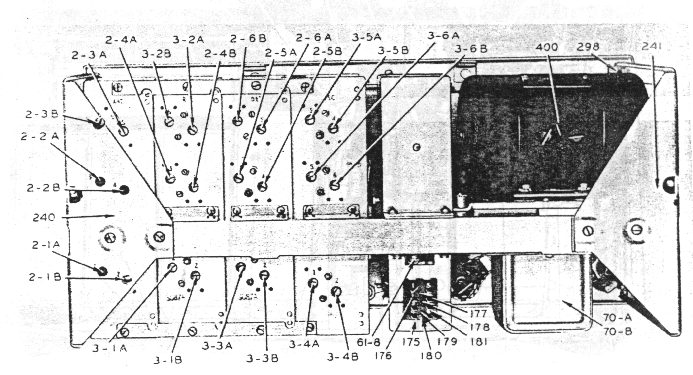
Figure 15 -- Radio Receiver BC-348-J, Rear View of Chassis
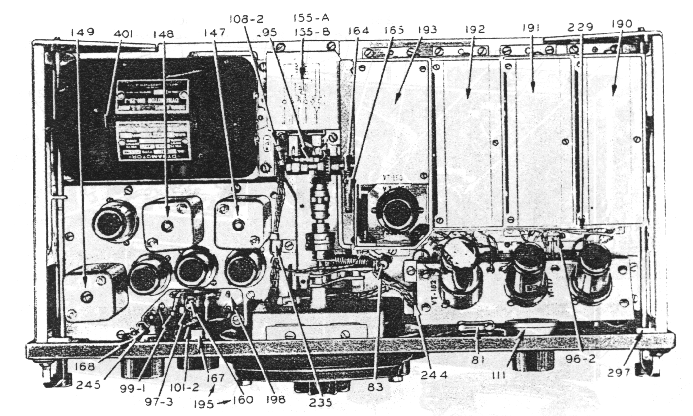
Figure 16 -- Radio Receiver BC-348-J, Top View of Chassis
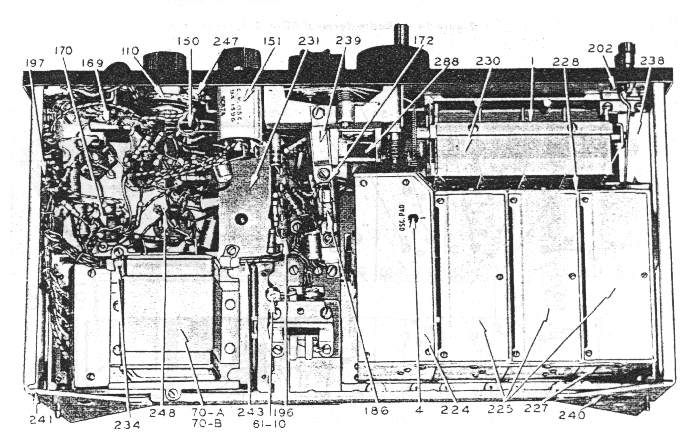
Figure 17 -- Radio Receiver BC-348-J, Bottom View of Chassis
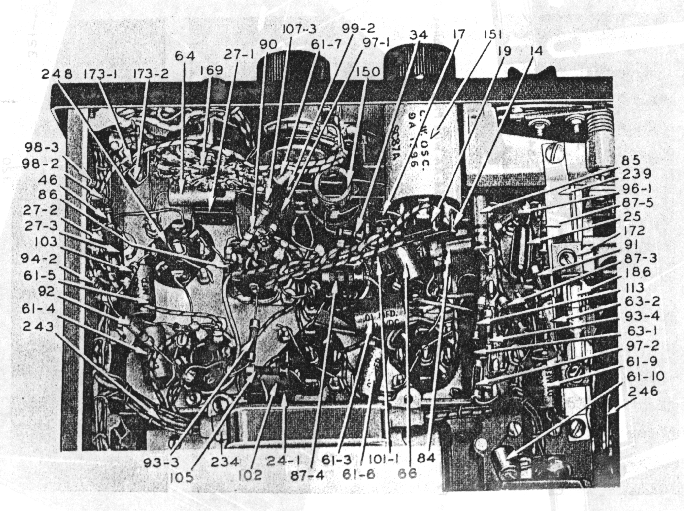
Figure 18 -- Radio Receiver BC-348-J, Partial Bottom View
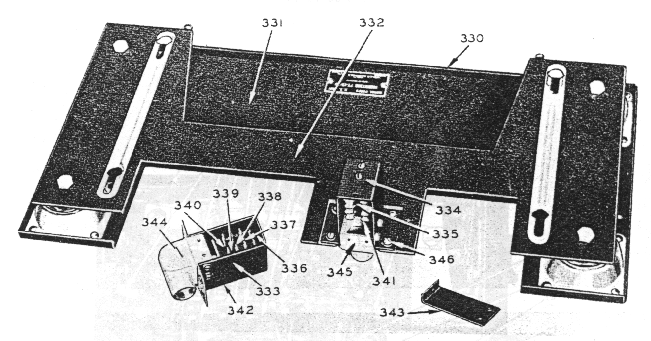
Figure 19 -- Mountings FT-154-J, FT-154-Q and FT-154-AA with Plug Assemblies, Rear View
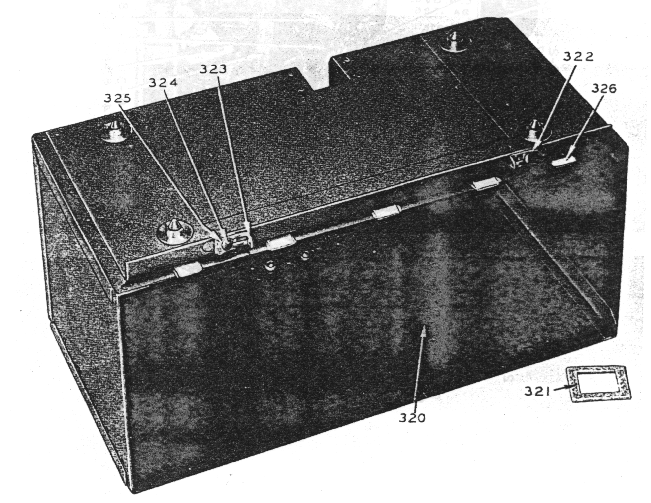
Figure 20 -- Radio Receiver BC-348-J, Front View of Cabinet
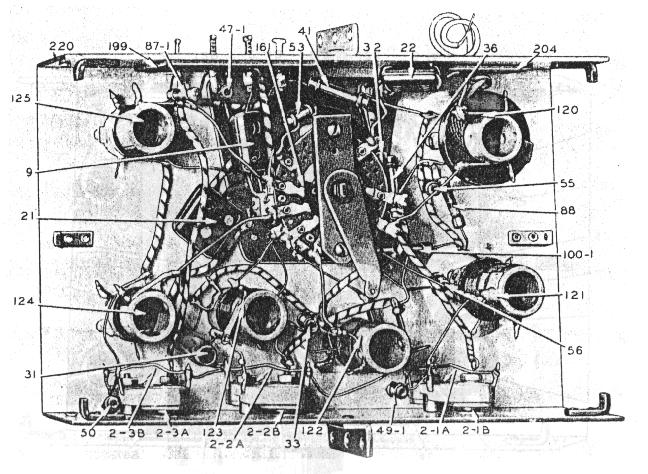
Figure 21 -- Antenna Unit
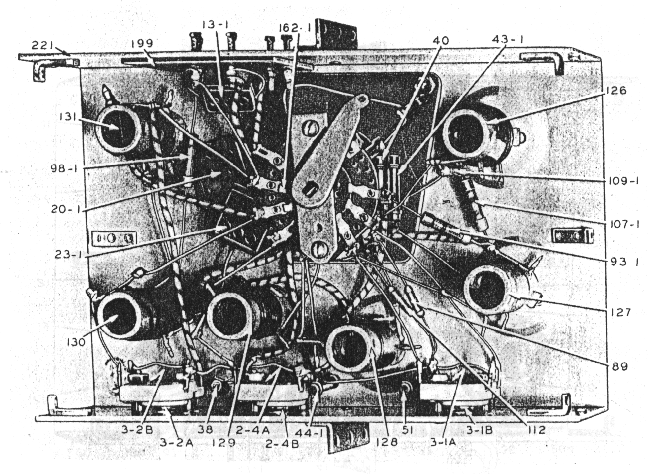
Figure 22 -- R.F. Unit
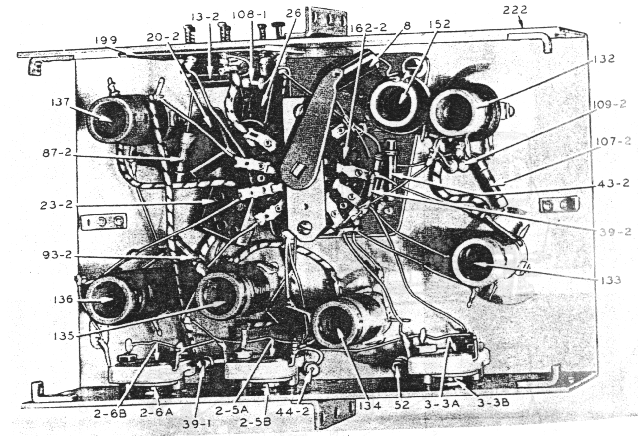
Figure 23 -- Detector Unit
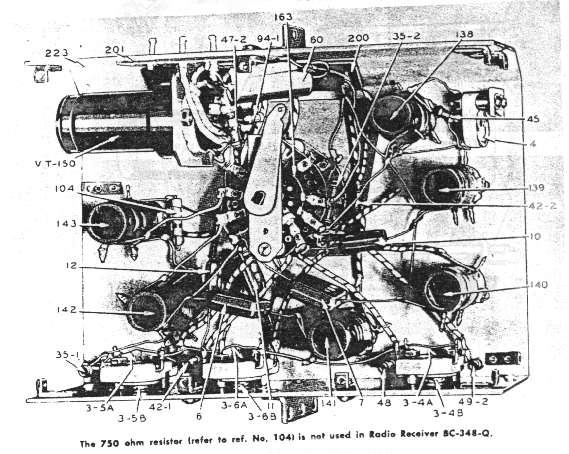
Figure 24 -- Oscillator Unit
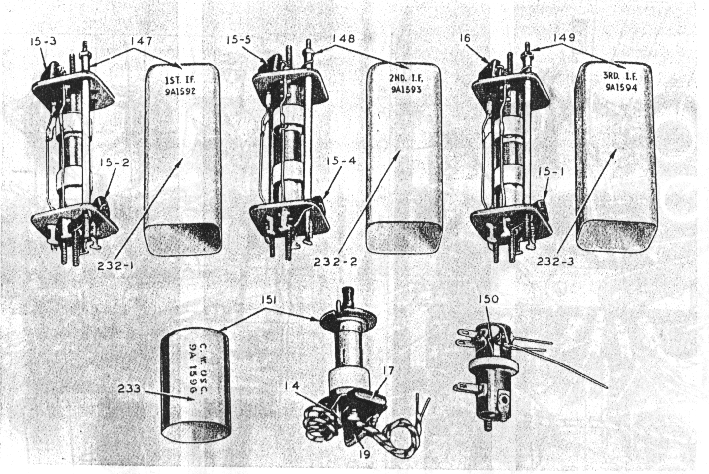
Figure 25 -- I-F C-W Oscillator and Crystal Coil Assemblies
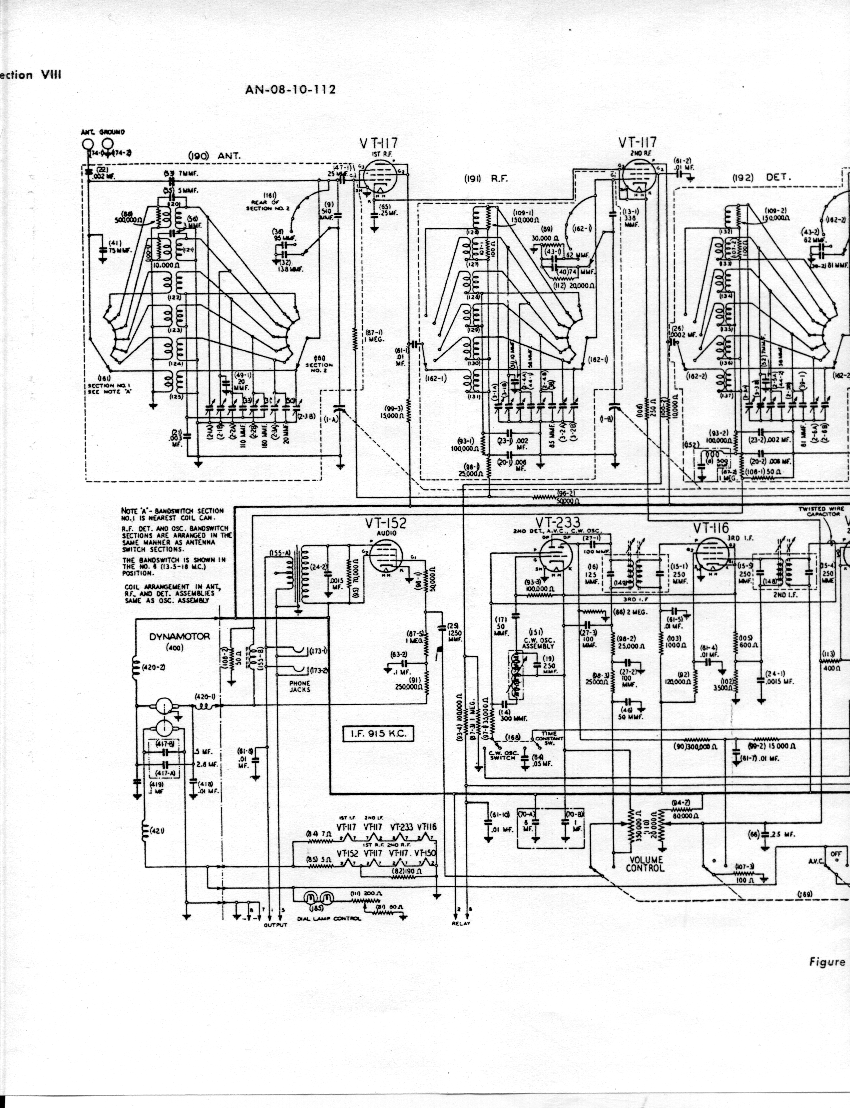
Figure 26-- Radio Receiver BC-348-J, Schematic Diagram (part 1)
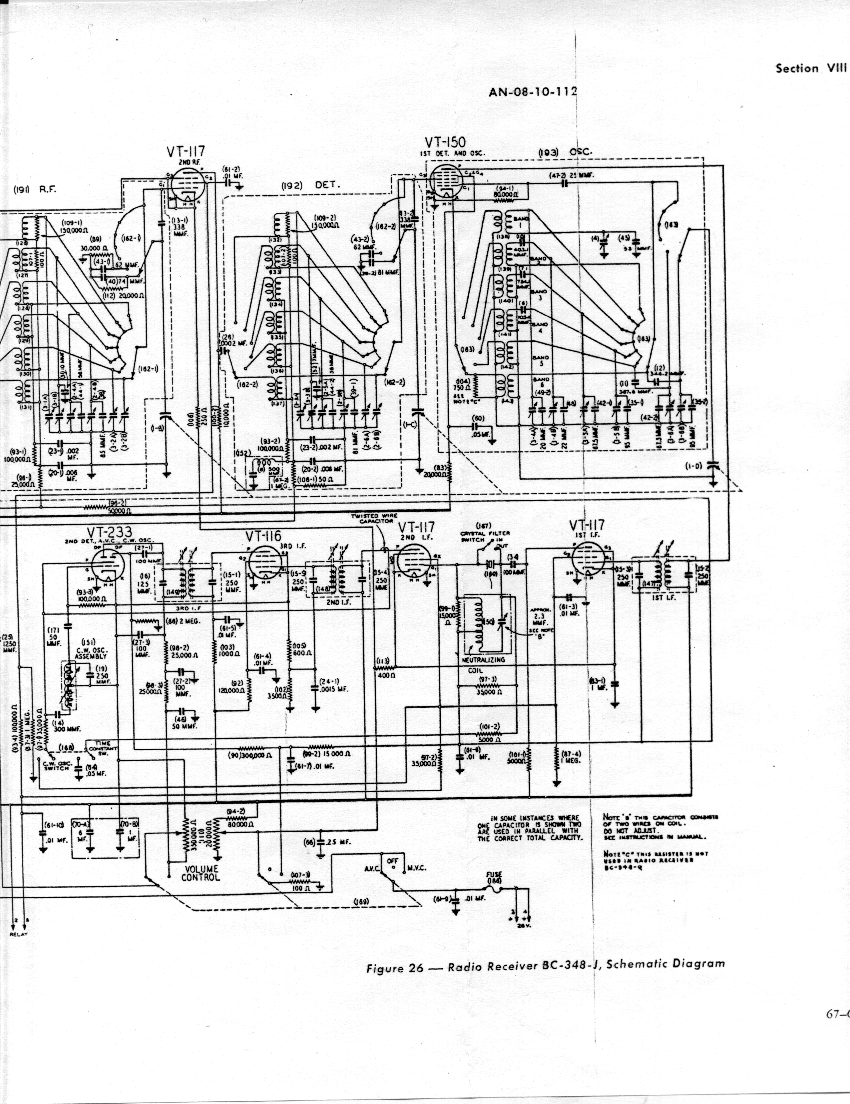
Figure 26-- Radio Receiver BC-348-J, Schematic Diagram (part 2)
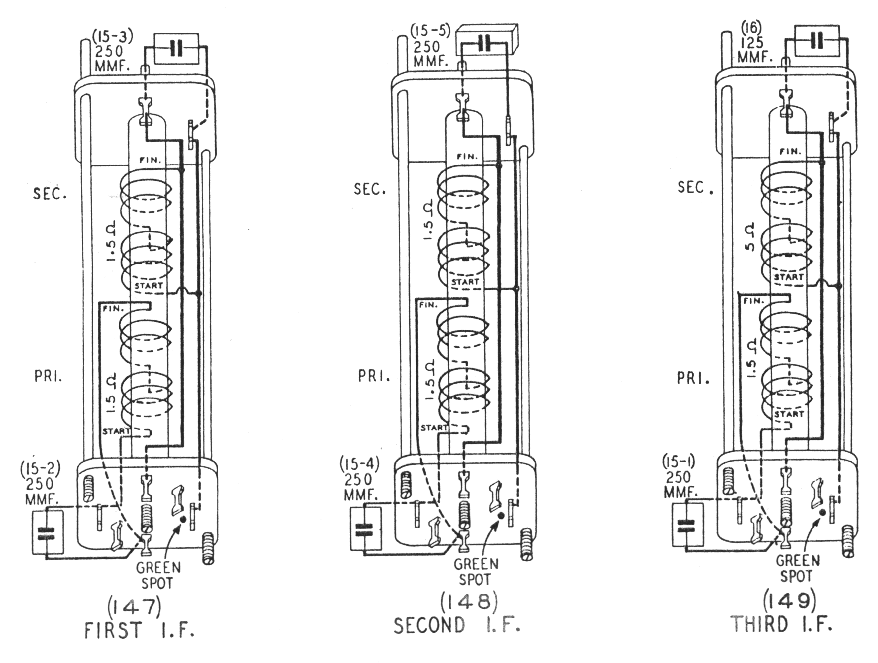
Figure 27-- I-F Transformers, Wiring Diagram
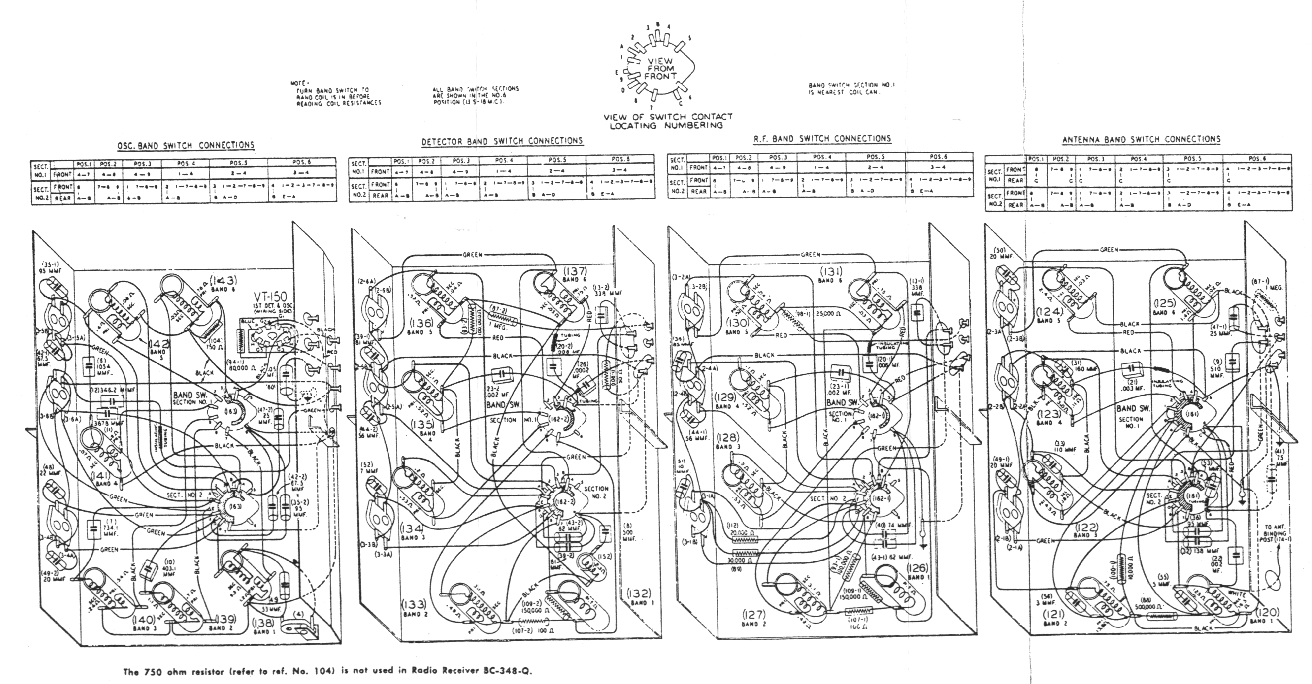
Figure 31-- Antenna, R.F., Detector and Oscillator Units, Wiring Diagram
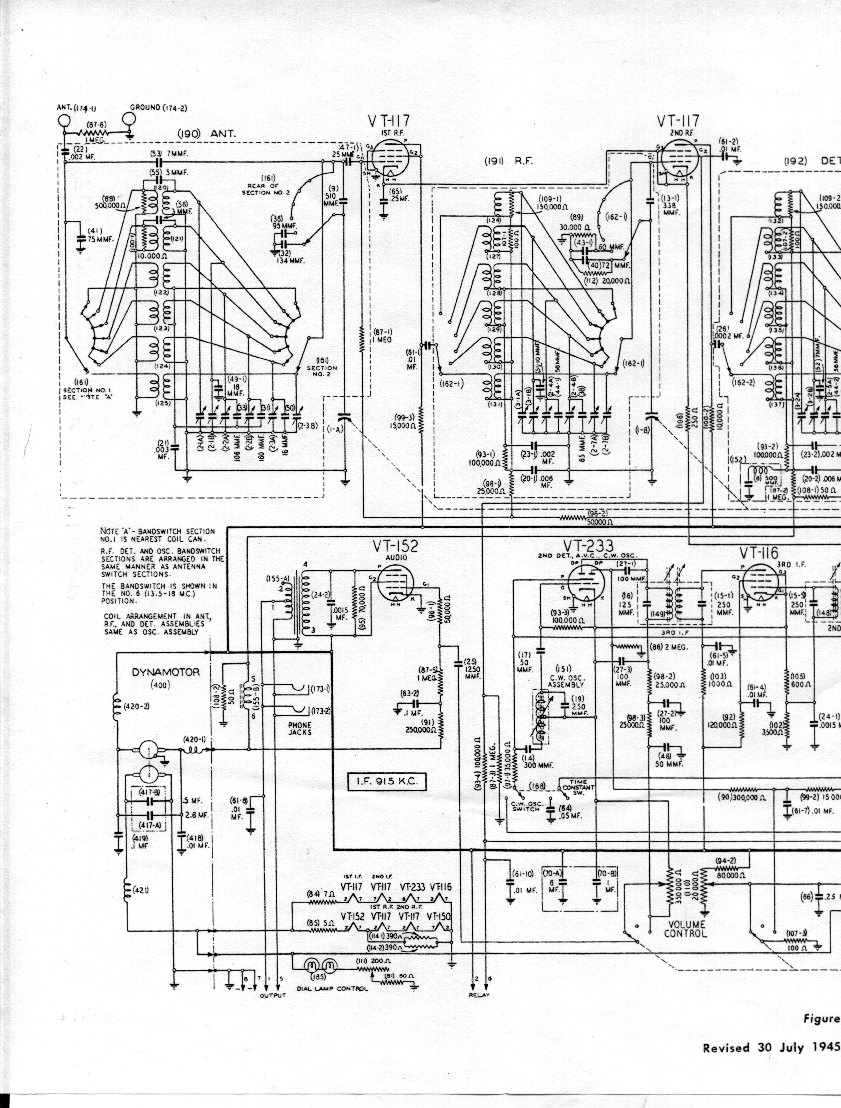
Figure 33-- Radio Receiver BC-348-Q, Schematic Diagram (part 1)
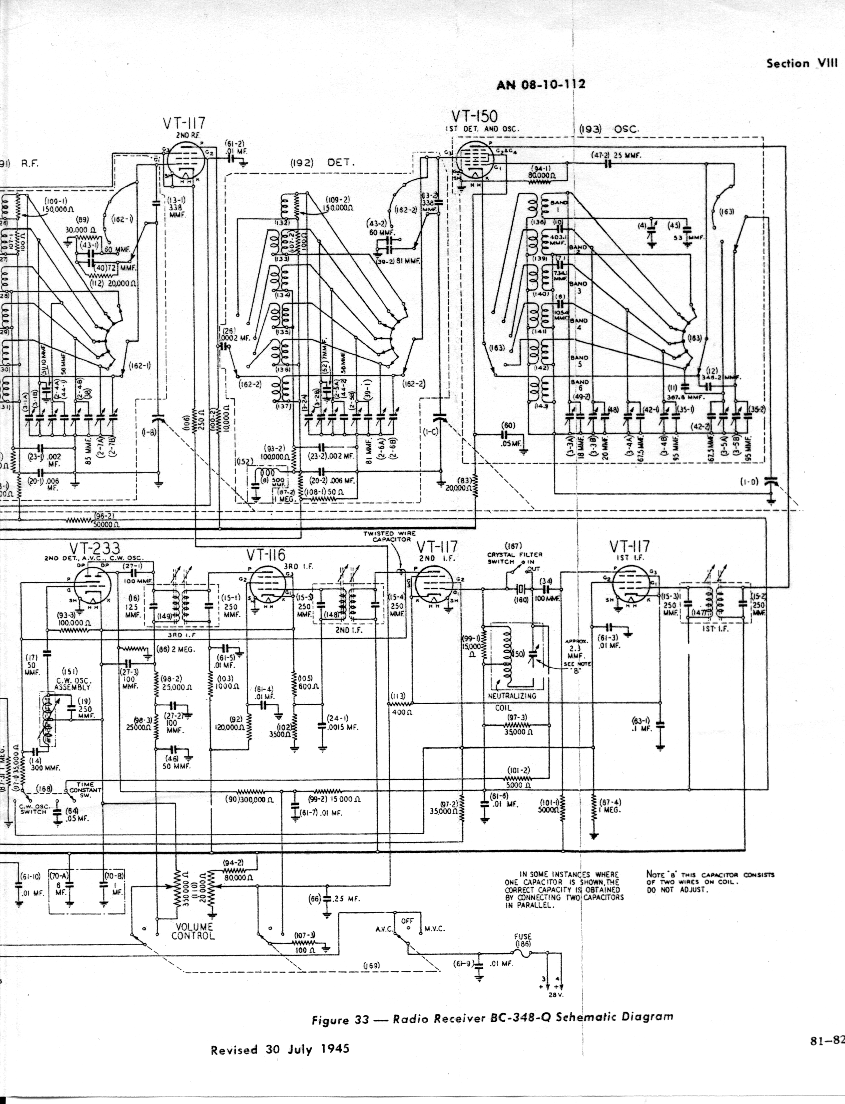
Figure 33-- Radio Receiver BC-348-Q, Schematic Diagram (part 2)
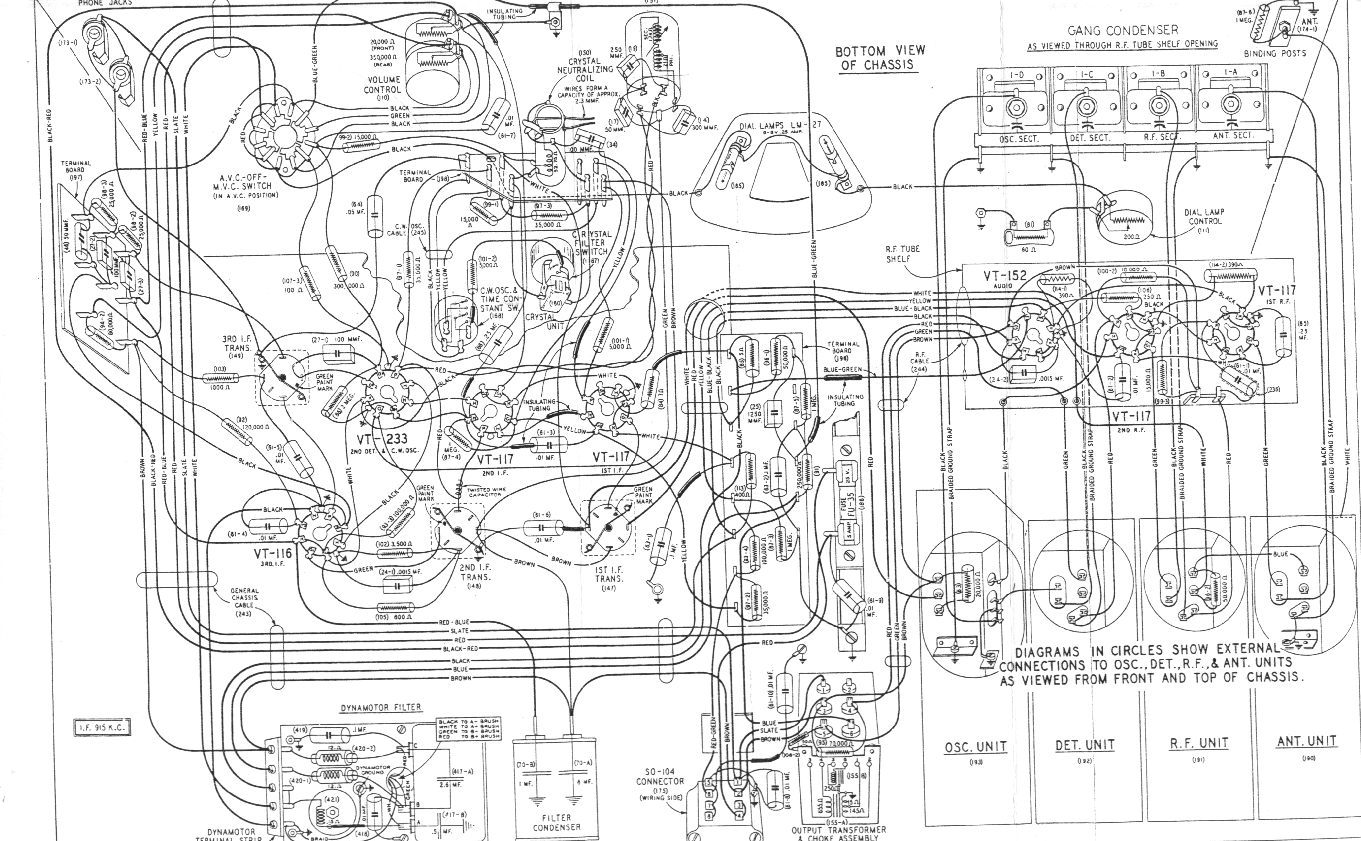
Figure 34-- Radio Receiver BC-348-Q, Wiring Diagram of Chassis